Cataract and Retina: Which Equipment Will Take Your Practice Further?
Moving from cataract surgery to a combined cataract–retina practice requires more than adding a vitrectomy mode. Fluidics, anterior chamber stability, vitreoretinal functions, consumables and technical support must work as one architecture. Here is how to assess a phaco-vitrectomy platform such as the R-Evo Smart CR.
محتوى المقال
- 1. Fluidics: the foundation of operative stability
- 2. Phacoemulsification: energy management and continuity of technique
- 3. Vitrectomy: assess more than the presence of a retinal mode
- 4. Interface and foot pedal: operative functions, not ergonomic details
- 5. Consumables and support: the operating economics of the platform
- A decision method suited to a combined practice
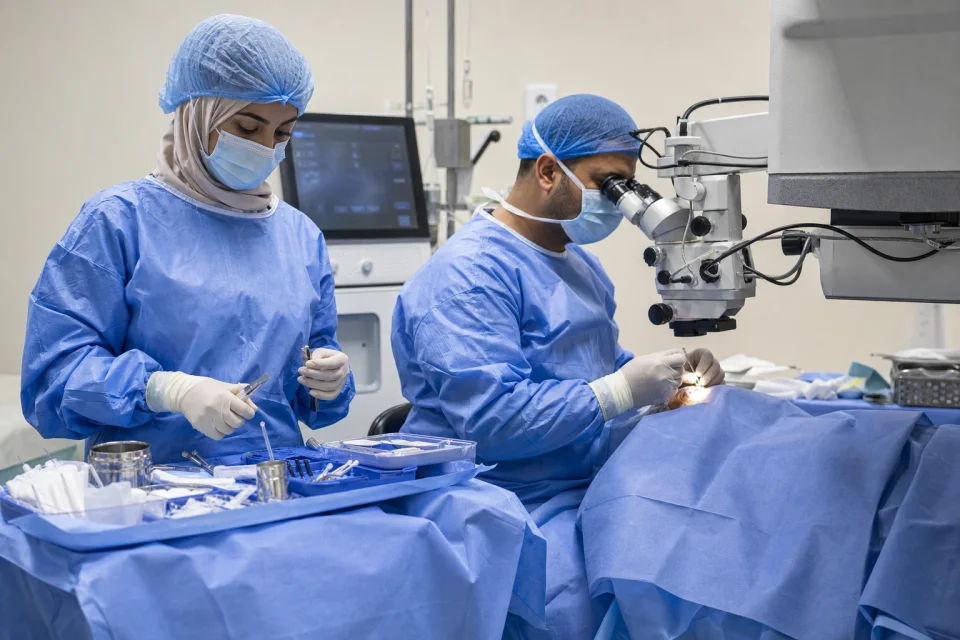
A cataract console may perform phacoemulsification effectively without being designed for the transitions inherent in vitreoretinal surgery. Once a combined service is considered, the assessment must include vitreous management, anterior chamber stability, aspiration selection, illumination, fluid–air exchange and consumable control. The decisive issue is therefore not whether a vitrectomy function appears in a specification sheet. It is how that function integrates with the platform, how it interacts with the fluidics and whether the team can move from a phacoemulsification logic to a vitreoretinal logic without multiplying preparation breaks. This architectural coherence determines the practical value of the investment.
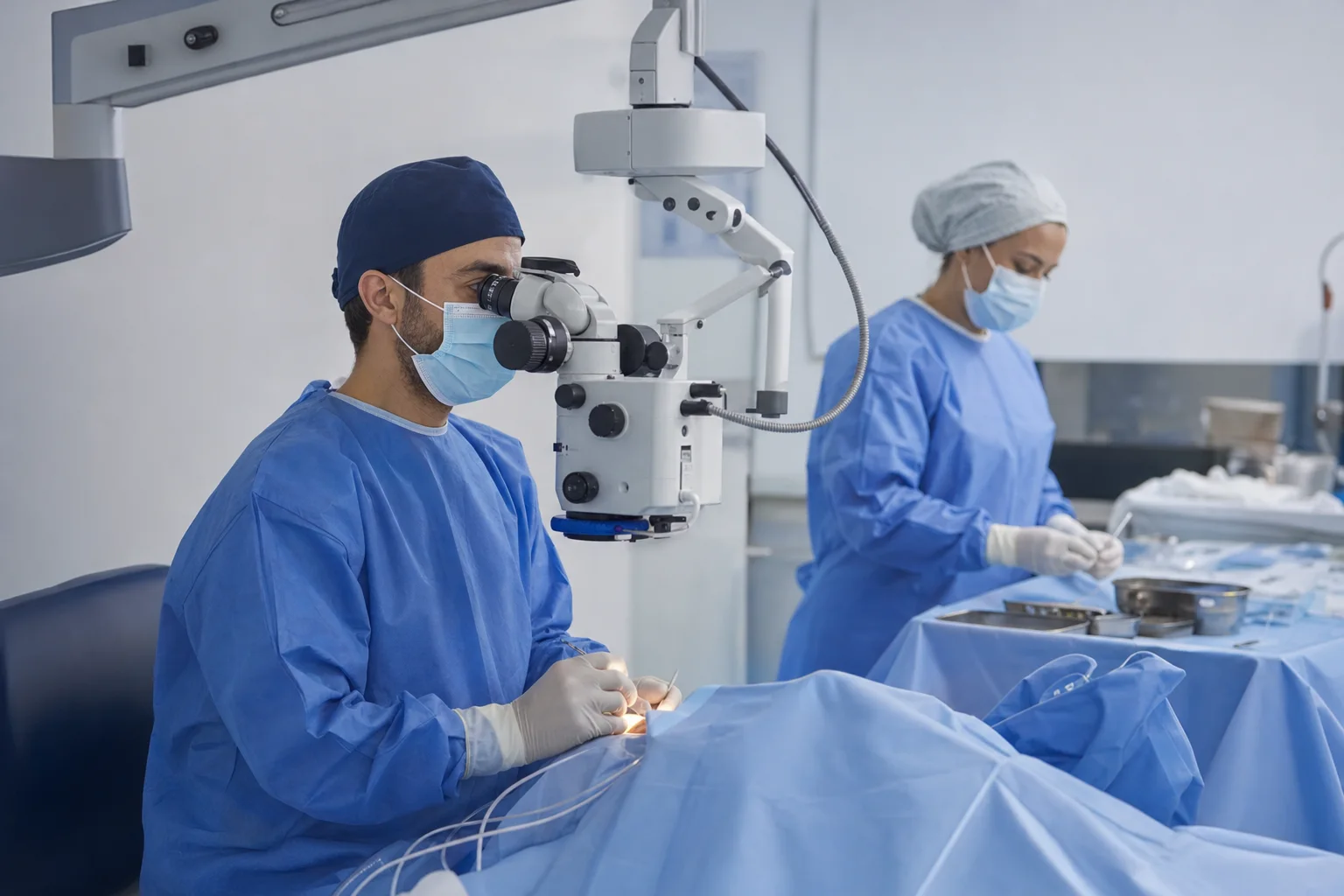
Before comparing platforms, define the operative scope the theatre must support. A combined practice may involve selected combined procedures, anterior vitrectomy, retinal detachment repair, cases requiring tamponade or a gradual expansion of the team’s vitreoretinal capability. These scenarios do not place the same demands on every function. The platform should therefore be assessed as part of a trajectory, not as a snapshot. Does it support the procedures the team already performs? Can retinal functions be introduced progressively? Are the accessories and consumables aligned with the intended cases? Can the technical partner support the surgeon, scrub team and biomedical lead with the same level of clarity? Those answers give the equipment decision operational meaning.
1. Fluidics: the foundation of operative stability
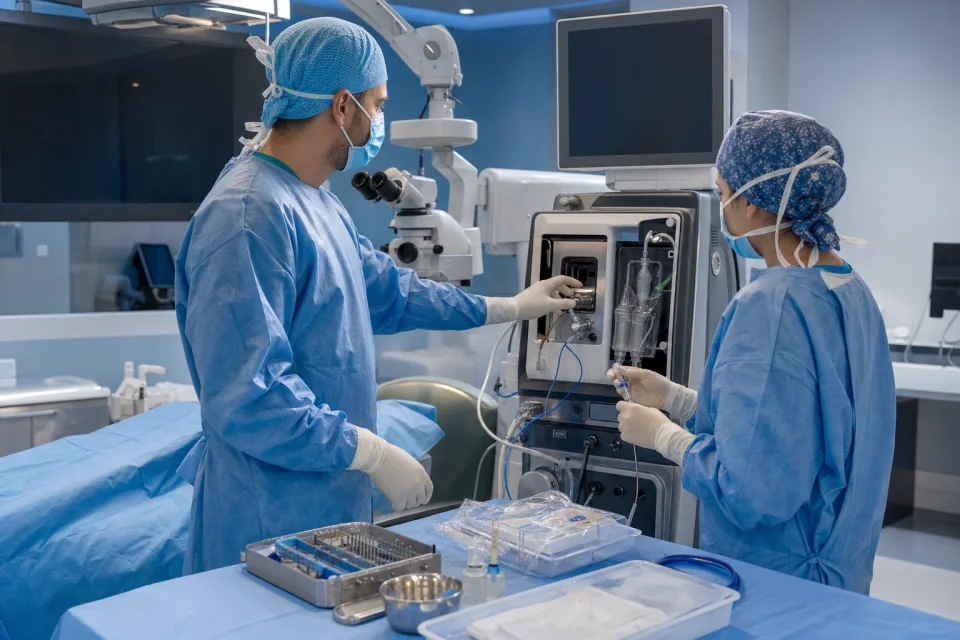
The pump determines how aspiration responds to the surgeon’s action. A flow-based approach and a vacuum-based approach create different relationships between command, material capture and surgical feedback. Selecting the approach appropriate to the procedure means that phacoemulsification and vitreoretinal surgery do not have to be treated as one identical fluidic situation. Active irrigation completes this architecture. By maintaining IOP through a controlled system, it contributes to the stability sought when anterior-segment conditions change. The practical consequence is that aspiration and irrigation are managed as an articulated system rather than as separate parameters. The common EasySys cassette also offers logistical continuity by bringing phaco, retinal and combined procedures into a shared consumable environment.
2. Phacoemulsification: energy management and continuity of technique
When a facility develops retinal surgery, phacoemulsification does not become a secondary function. It remains the daily foundation of the service and must retain precision, clarity and efficiency, including when the platform is used for more complex cases. The interest of a structured energy-management system is the predictable relationship between the selected protocol, handpiece response and surgical progression. The option of pars plana phaco extends the platform’s scope: it does not replace clinical judgement, but it adds continuity when the operative strategy involves both segments. This ability to support routine cataract work while opening a path towards combined surgery is central to the platform’s relevance.
3. Vitrectomy: assess more than the presence of a retinal mode
Vitrectomy is not simply a matter of cutting and aspiration. Visualisation must remain usable, exchanges must fit into a controlled sequence and diathermy must be available when the surgical strategy requires it. Two independent LED light sources allow illumination to be treated as an active workflow function rather than an isolated accessory. Similarly, fluid–air exchange and silicone oil management give the platform a role in more complete surgical scenarios. The technical value becomes clear when these functions are available throughout the procedure, with an interface and preparation process that do not unnecessarily fragment the team’s work. For the surgeon, this means a platform capable of accompanying the sequence; for the theatre, a more legible preparation logic.
4. Interface and foot pedal: operative functions, not ergonomic details
In surgery, ergonomics is not measured only by screen size. It is measured by how quickly the team can find the relevant parameter, distinguish the stages of the procedure and maintain stable control as the surgical situation changes. A programmable foot pedal should be assessed in a realistic setting: position, command logic, transitions between functions and compatibility with the surgeon’s established habits. The screen should be readable from the operating position and present information in an understandable hierarchy. Audio feedback can complement visual information when configured appropriately. An ASEM demonstration should therefore be practical: configure a phaco scenario, transition to a vitreoretinal sequence, verify the commands and observe the scrub team’s workflow.
5. Consumables and support: the operating economics of the platform
A platform may be technically convincing yet difficult to operate if consumables, packs, accessories and maintenance are not aligned with the planned procedures. The correct calculation is not limited to the acquisition price. It examines the relationship between intended cases, cassette, available packs, parts availability and the distributor’s ability to maintain technical continuity. For a combined service, this analysis should involve the surgeon, scrub nurse, procurement lead and biomedical manager. A common cassette for phaco, retinal and combined procedures may simplify preparation, but that benefit must be confirmed against the configuration actually offered and the catalogue accessible locally. ASEM helps connect the manufacturer’s stated performance with the practical constraints of the theatre.
A decision method suited to a combined practice
Criteria to validate during the demonstration
- Define the procedures genuinely planned and distinguish combined cases from vitrectomy-only cases.
- Observe fluidic stability and clarity when the aspiration mode changes.
- Test the interface and foot-pedal logic against the surgeon’s working habits.
- Verify the sequence between phacoemulsification, vitrectomy, fluid–air exchange, diathermy and tamponade management according to the selected configuration.
- Review the cassette, packs, accessories, single-use instruments and consumable availability.
- Assess initial training, technical support, maintenance and escalation pathways in the event of an incident.
- Confirm labelling, authorised indications and availability of each element for the relevant market.
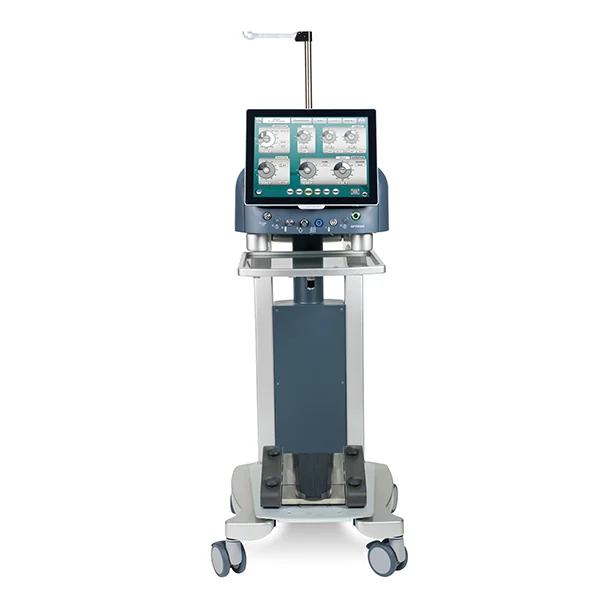
The R-Evo Smart CR brings together several attributes that are particularly coherent with the move towards a combined practice: a compact, modular architecture, dual pump technology, active irrigation management, phacoemulsification and vitrectomy functions, independent illumination, exchanges, diathermy and a programmable interface. None of these elements should be assessed in isolation. Their interest lies in how they interact across one operative pathway. For the specialist, this coherence can focus the decision on indications and surgical quality rather than on repeated platform changes. For the theatre, it supports a more structured approach to preparation and consumables. For management, it provides a clearer basis for planning investment, training and technical support. This combination makes the R-Evo Smart CR a serious candidate for evaluation in a combined cataract–retina practice, subject to validation of the local configuration.
مشاركة المقال
الأسئلة الشائعة المهنية
Why is a phaco-vitrectomy platform relevant to a combined practice?
It brings together the functions required for phacoemulsification and vitrectomy in an architecture intended to reduce workflow breaks between the two procedure families. Its suitability still depends on the planned indications, selected configuration and operating-theatre organisation.
What should be assessed beyond the console itself?
Review fluidics, pumps, IOP management, consumables, procedure packs, vitreoretinal accessories, training, maintenance and local availability. The interface and foot-pedal ergonomics should also be assessed in a realistic surgical scenario.
Is the R-Evo Smart CR suitable for every retinal surgery service?
BVI Medical presents it as a phaco-vitrectomy system with vitreoretinal functions, including support for combined procedures. Suitability for a specific service must be confirmed according to the intended indications, configuration, applicable labelling and accessories available in the relevant market.
Why should the decision between vitrectomy alone and a combined procedure remain clinical?
The supplied literature describes advantages and limitations for both strategies. The decision depends on the patient, lens, retina, refractive strategy, surgeon expertise and care setting. Equipment should support that decision, not replace it.
المصادر والمراجع
المنتج الرسمي
-
R-Evo Smart CR
BVI Medical · R-Evo Smart CR · www.bvimedical.com
تم الاطلاع في 2026-10-14
Institutional Source
-
Pars Plana Vitrectomy Alone or Combined with Phacoemulsification to Treat Rhegmatogenous Retinal Detachment: A Systematic Review of the Recent Literature - PMC
BVI Medical · R-Evo Smart CR · pmc.ncbi.nlm.nih.gov
تم الاطلاع في 2026-10-14
الكتالوج الرسمي
-
BVI ophthalmic consumables
BVI Medical · www.bvimedical.com
تم الاطلاع في 2026-10-14
فعاليات ذات صلة بهذا الموضوع

Vision to Venture Weekend 1
Budapest, المجرEuropean Society of Cataract and Refractive Surgeons
A professional ophthalmology event organised by European Society of Cataract and Refractive Surgeons. Plea...
15e Congrès ARMD — Rétine et révolutions
Antibes Juan-les-Pins, فرنساAssociation Rétine Macula Dégénérescences
A professional ophthalmology event organised by Association Rétine Macula Dégénérescences. Please consult...
Special Focus Meeting 2027 - Inherited Retinal Diseases
Ljubljana, سلوفينياEURETINA
A professional ophthalmology event organised by EURETINA. Please consult the official source for the lates...