Reduced Vision After Cataract Surgery: When Should You Treat with Nd:YAG?
A visible posterior capsule opacity is not, by itself, an indication for Nd:YAG capsulotomy. Here is how to establish clinical concordance before treatment—and where the Q-Las fits into a structured laser pathway.
En este artículo
- The first decision is concordance—not simply the presence of opacity
- Structure the assessment before scheduling the laser
- 1. Revisit the complaint and the refraction
- 2. Examine the anterior segment with a specific question
- 3. Keep the posterior segment in the reasoning
- Assessing the capsule: move from visibility to optical impact
- Where the laser choice extends the quality of the diagnosis
- Why the Q-Las architecture matters during the procedure
- Do not confuse technical capability with indication quality
- A clearer, more defensible and more effective Nd:YAG decision
The presentation is familiar: a pseudophakic patient returns with less sharp vision, reduced contrast, glare, halos or general functional dissatisfaction. Examination shows that the posterior capsule is no longer fully transparent. It is tempting to label the finding as secondary posterior capsule opacity and proceed directly to laser scheduling. Yet the quality of the indication is determined before the first shot. The central discipline in a well-structured Nd:YAG pathway is to distinguish the presence of an opacity from its actual clinical responsibility.
The first decision is concordance—not simply the presence of opacity
The complaint should be characterised precisely. A measured reduction in acuity, degraded image quality, distance-vision difficulty, glare and reduced performance in low contrast do not necessarily reflect the same mechanism. The clinician must relate the symptom to the relevant optical pathway and to the apparent significance of the capsule finding. A mild opacity outside the routinely used pupillary axis does not carry the same decision weight as a central opacity directly over the visual axis.
Structure the assessment before scheduling the laser
1. Revisit the complaint and the refraction
Refraction is a simple but decisive diagnostic filter. Residual refractive error, a refractive change or suboptimal optical quality may contribute to the patient’s dissatisfaction without the capsule being the dominant factor. The examination should distinguish the vision achieved with the relevant correction from the patient’s subjective perception. This comparison helps prevent the laser from being used to address a difficulty that primarily requires optical correction or investigation of another component of the visual system.
2. Examine the anterior segment with a specific question
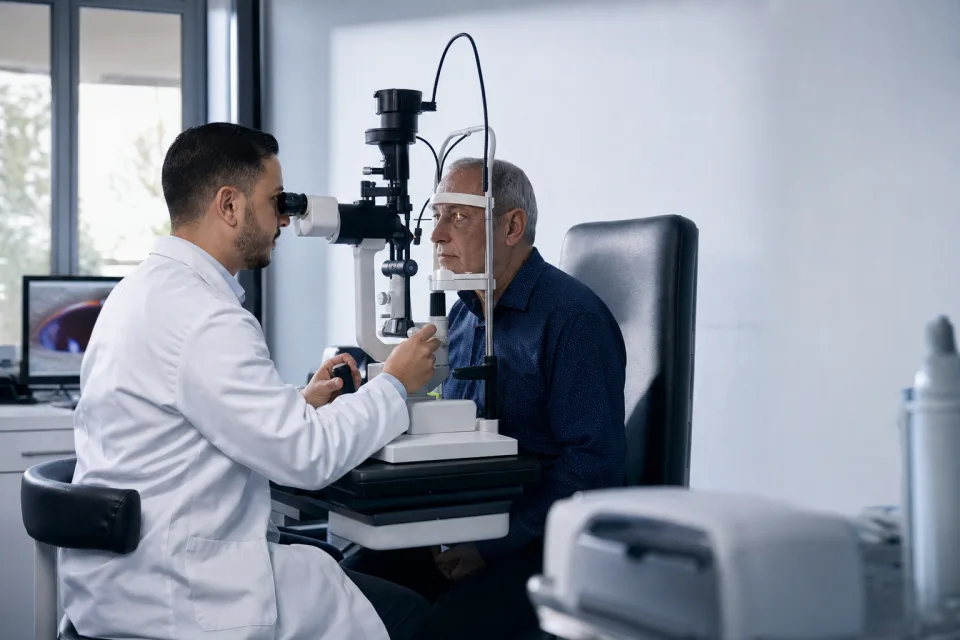
Slit-lamp examination should do more than confirm that an opacity exists. It should define its location, extent, apparent density and relationship to the pupillary axis. Corneal status, tear film, anterior chamber, intraocular lens and capsule should be interpreted within the same clinical argument. The useful question is not merely, “Is the capsule opaque?” It is: “Is this opacity located and significant enough to explain this complaint under these visual conditions?”
3. Keep the posterior segment in the reasoning
When reduced vision appears disproportionate to the capsular appearance, the assessment must change scale. The macula, optic nerve head, retina and the patient’s vascular or metabolic context may alter the interpretation completely. If the capsule makes posterior-segment examination difficult, that may support the practical value of treatment, but it does not remove the need for a global clinical assessment. The laser must not become a substitute for identifying the cause of visual loss.
Assessing the capsule: move from visibility to optical impact
The decision becomes more robust when the opacity is described in terms of its likely effect on the visual axis. Peripheral, central and irregular changes do not necessarily affect perception in the same way. Lighting, pupil behaviour and the patient’s visual demands may also influence the complaint. This functional reading avoids two symmetrical errors: treating an opacity that contributes little, or delaying treatment when the capsule clearly interferes with the optical pathway.
The indication rests on the intersection of the reported symptom, relevant visual measurement, refraction, opacity topography and consistency with the rest of the examination. The more precise the concordance, the more defensible the Nd:YAG procedure.
This approach also improves the patient discussion. The clinician can explain that the laser is directed at a structure identified as clinically contributory, rather than at an undifferentiated reduction in vision. That distinction supports informed expectations: the likely benefit depends on the proportion of the complaint genuinely attributable to the capsule. A macular, retinal, glaucomatous, corneal or ocular-surface cause requires a different evaluation and management pathway.
Where the laser choice extends the quality of the diagnosis
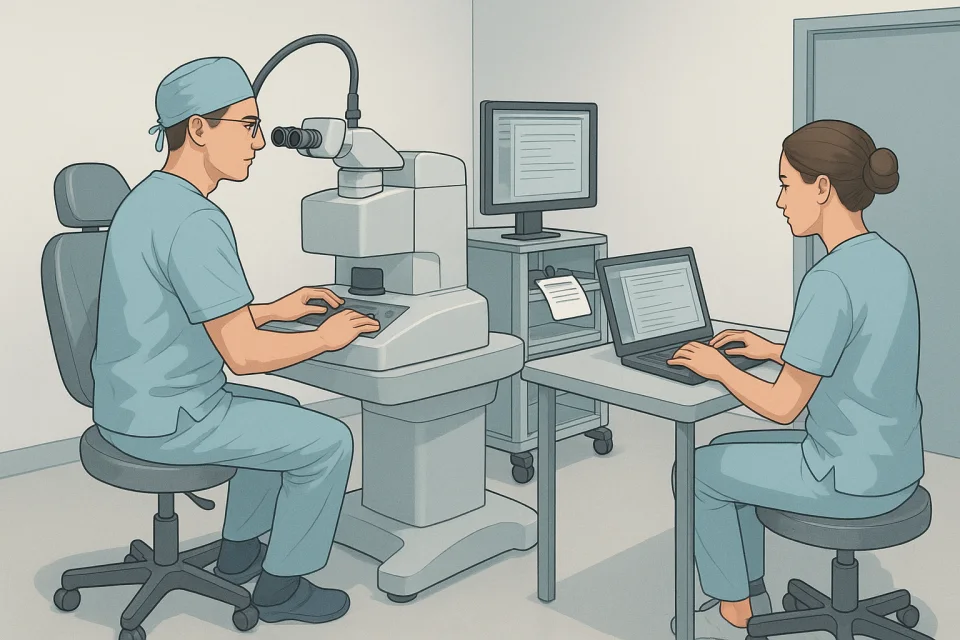
Once the indication has been established, it must be translated into a controlled procedure. The Nd:YAG platform supports the second stage of the pathway: visualising the target, focusing, delivering energy and managing the treatment with ergonomics suited to routine practice. Equipment does not replace diagnosis. However, a well-considered architecture narrows the gap between the clinical decision and its technical execution.
Why the Q-Las architecture matters during the procedure
A.R.C. Laser presents the µ-Chip technology with pulse-to-pulse stability and no thermal influence from the cavity in the laser design. For the specialist, the interest is not limited to a specification sheet. Stable emission supports procedural reproducibility and consistency in energy delivery. The diode-pumped design also avoids the UV exposure of the Q-switch cell associated with flashlamps, an element of the architecture’s stated long-life and reliability rationale.
The dual-target beam addresses a different requirement: accurate focusing. In capsulotomy, reliable alignment of the impact zone supports the quality of the manoeuvre and operator confidence. The coaxial laser beam and slit illumination extend the same visualisation logic, while the integrated Clear-View filter technology is intended to support comfortable observation of the treatment area. Ergonomics therefore has an indirect clinical value: it helps maintain continuity between observation, centration and delivery.
Q-Las energy can be adjusted from 0.5 to 10 mJ, with changes between Burst-Mode levels available through a dedicated control. These specifications are not therapeutic indications in themselves. They give the specialist tools with which to adapt procedure management to the observed situation and the chosen operating strategy. Clinical judgement remains primary, but the interface should make that strategy clear and immediately usable.
Do not confuse technical capability with indication quality
Nd:YAG laser is a targeted response to a posterior capsule opacity that is genuinely contributory. It does not correct symptomatic ocular-surface disease, an unoptimised refractive error, macular pathology or optic neuropathy. Conditions that may not necessarily produce visual impairment but can cause pain or discomfort—such as dry eye, conjunctivitis and blepharitis—must also remain in the clinical analysis when the presentation suggests them.
This distinction protects both the quality of care and the value of the procedure. It allows the clinician to reserve capsulotomy for situations in which it addresses an identified mechanism, while directing other patients towards the appropriate examination or treatment. In a premium clinical pathway, patient selection and execution quality are inseparable.
A clearer, more defensible and more effective Nd:YAG decision
Before treatment, the specialist should be able to formulate a straightforward conclusion: the complaint is compatible with reduced visual quality; correction alone does not adequately explain it; the opacity lies on the optical pathway and is sufficiently contributory; and no alternative cause dominates the clinical picture. This formulation clarifies the indication and gives the laser procedure a defined purpose.
This is where Q-Las takes its place. Its intended use in capsulotomy and iridotomy, Q-switched Nd:YAG technology, dual-target-beam focusing, coaxial illumination and ergonomic functions form a coherent architecture for a structured laser service. ASEM does not present the device as a diagnostic shortcut. We position it as a technical partner for a documented clinical decision—one that begins with concordance and continues through controlled execution.
Compartir el artículo
Preguntas frecuentes profesionales
Does posterior capsule opacity automatically justify Nd:YAG treatment?
No. The opacity must be sufficiently contributory to explain the patient’s visual complaint. The decision should reflect concordance between symptoms, relevant visual acuity, refraction, slit-lamp findings and the absence of a more relevant alternative cause.
What should be documented before Nd:YAG capsulotomy?
Document the patient’s complaint, relevant visual acuity, refraction, corneal and ocular-surface status, implant position and condition, posterior capsule findings and the accessible posterior-segment findings.
What role does Q-Las play in this pathway?
Q-Las is a Q-switched Nd:YAG platform intended for capsulotomy and iridotomy. Its value lies in supporting visualisation, focusing and ergonomic control during the procedure, once the clinical indication has been established.
Can Nd:YAG laser resolve every case of reduced vision after cataract surgery?
No. Reduced vision may have several causes. If the capsule does not adequately explain the complaint, the assessment should be redirected towards other ocular structures and conditions that may reduce vision or cause discomfort.
Fuentes y referencias
Producto oficial
-
Q-Las
A.R.C. Laser · Q-Las · www.arclaser.de
Consultado el 2026-10-07
Institutional Source
-
Eye care, vision impairment and blindness
A.R.C. Laser · Q-Las · www.who.int
Consultado el 2026-08-09 -
Blindness and vision impairment
A.R.C. Laser · Q-Las · www.who.int
Consultado el 2026-08-09
Catálogo oficial
-
A.R.C. Laser ophthalmology portfolio
A.R.C. Laser · intern.arclaser.com
Consultado el 2026-10-07
Eventos relacionados con este tema

Vision to Venture Weekend 1
Budapest, HungríaEuropean Society of Cataract and Refractive Surgeons
A professional ophthalmology event organised by European Society of Cataract and Refractive Surgeons. Plea...
31st ESCRS Winter Meeting
Le Caire, EgiptoEuropean Society of Cataract and Refractive Surgeons
A professional ophthalmology event organised by European Society of Cataract and Refractive Surgeons. Plea...
ASCRS Annual Meeting 2027
San Diego, Estados UnidosAmerican Society of Cataract and Refractive Surgery
A professional ophthalmology event organised by American Society of Cataract and Refractive Surgery. Pleas...