Ptosis and Plasma: Indications, Limits and the Place of Plexr Pro
In mild-to-moderate upper-eyelid ptosis, plasma should not be positioned as a surgical replacement by default. It may be discussed only after precise anatomical assessment, a coherent superficial target and indication-specific consent.
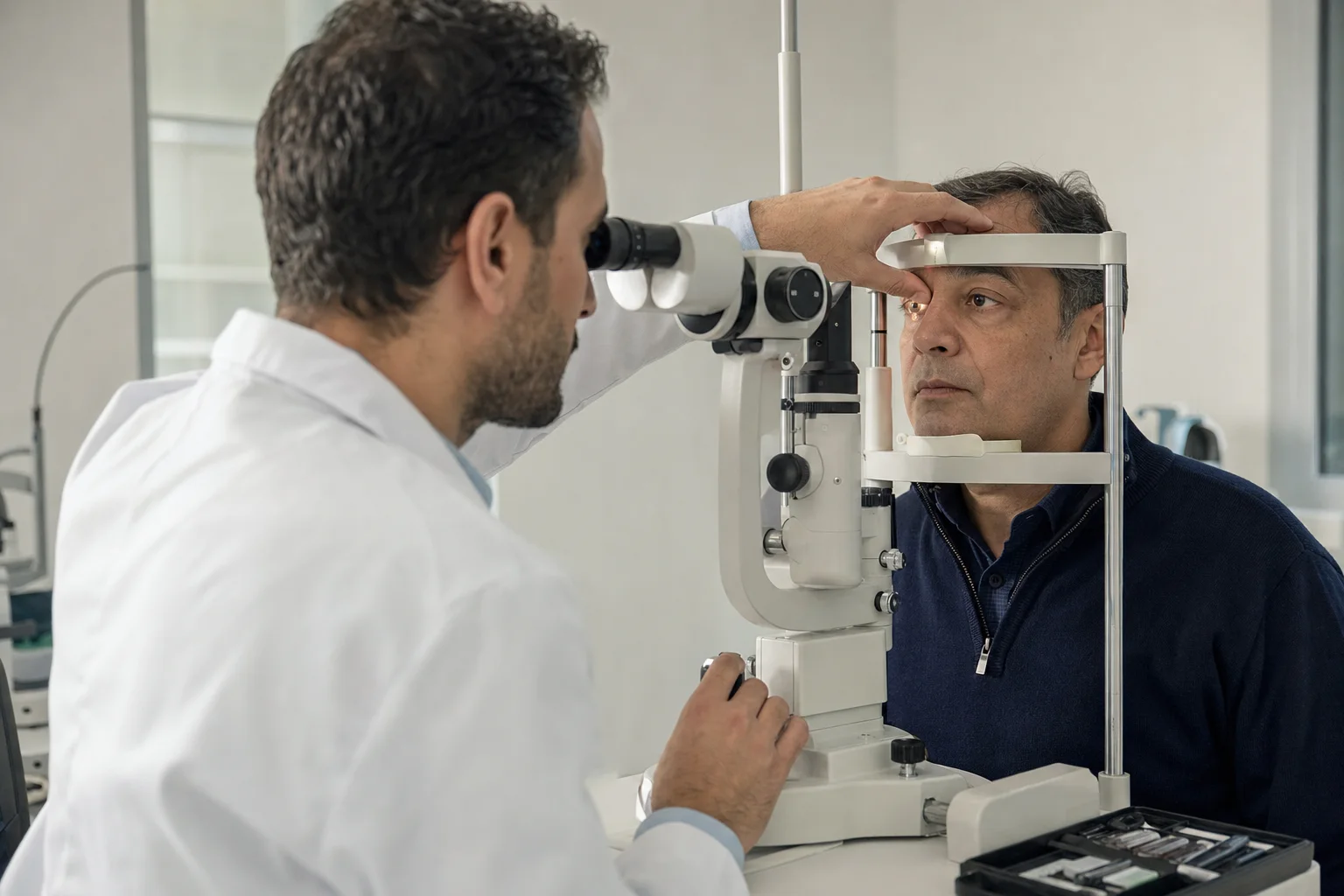
When a patient presents with a moderately low upper eyelid, the examination must first establish which structure is reducing the palpebral aperture. Possible contributors include levator dysfunction, aponeurotic dehiscence or disinsertion, Müller muscle dysfunction, dermatochalasis, tissue loading, brow compensation or a combination of mechanisms. Palpebral fissure height, margin reflex distance, levator function, eyelid crease, brow position, ocular motility, pupils and symmetry all contribute to the decision. These measurements should guide treatment selection rather than serve to justify a device chosen in advance.
1. Define the target before selecting the energy
Apparent severity is not sufficient. The upper eyelid may appear low because the upper-eyelid margin is genuinely displaced downward, because redundant skin obscures the crease, because brow recruitment is masking the defect, or because the patient has broader orbital and eyelid asymmetry. The essential distinction is between excess skin and true descent of the upper-eyelid margin. A superficial intervention may modify the cutaneous envelope, but it should not be presented as a correction for every form of ptosis.
The technical interest of micro-plasma lies in separating energy delivery from conventional incision. A controlled arc creates a localized, superficial action; the documented mechanism is therefore different from cutting or conventional cauterization. In practice, this opens a discussion for selected surface procedures when the objective concerns the eyelid envelope rather than deep structural reconstruction. It also requires precise marking, controlled working distance and an exact understanding of the tissue zone being treated. The mechanism itself does not establish an indication for every ptosis phenotype.
GMV lists Plexr Pro as an essential and versatile Plexr system based on plasma technology. For an ophthalmologist exploring minimally invasive oculoplasty, its value is not to promise a new form of ptosis surgery. Its role is to provide a device coherent with selected superficial objectives in a clinical setting, provided that the indication is correctly framed. The distinction between the selected product, Plexr Pro, and Plexr Plus is important. Detailed characteristics published for Plexr Plus must not automatically be attributed to Plexr Pro. Device configuration, handpieces, settings and available support should be confirmed with ASEM before implementation.
2. The eyelid mechanism determines whether plasma is relevant
A plasma discussion may be logical when examination identifies limited dermatochalasis, superficial redundancy or an irregularity of the eyelid envelope that contributes to a heavy-lid appearance. In this scenario, the intended action concerns the surface and the appearance of the tissue, not direct traction on the upper-eyelid margin. The clinical wording should remain exact: the treatment addresses a cutaneous or periocular component; it does not mechanically repair the levator.
Downward displacement of the upper-eyelid margin caused by levator insufficiency, aponeurotic disinsertion, neuromuscular dysfunction or a neurological cause requires a different line of reasoning. Surgery can act on the responsible structures according to the selected technique, whereas a superficial intervention does not address the primary mechanism. Associated excess skin must not obscure this anatomical hierarchy. A more favourable surface appearance is not necessarily a restoration of functional eyelid elevation.
3. Build a clinically defensible decision
An ASEM evaluation sequence
- Document asymmetry and the position of the upper-eyelid margin at rest, in primary gaze and with attention to frontal compensation.
- Measure levator function, assess the eyelid crease and look for motility, pupillary or ocular-surface findings that would change management.
- Separate the cutaneous component from true upper-eyelid margin ptosis, and state whether the objective is aesthetic, functional or mixed.
- Confirm that the proposed plasma area is genuinely a superficial target and that treatment will not make asymmetry more visible.
- Discuss alternatives, including observation, surgery adapted to the mechanism and, where clinically justified, additional investigation.
- Record standardized photographs and define follow-up criteria for healing, symmetry and achievement of the stated objective.
Clinical value depends on control of the complete treatment architecture: patient identification, mapping of the treatment area, protection of adjacent structures, selection of energy according to a validated protocol, observation of tissue response and follow-up. GMV describes multiple power levels and handpieces for different depths and skin conditions on the Plexr Plus page. These features illustrate the importance of personalization, but they are not a prescription for ptosis and must not be transferred to another model or clinical indication without appropriate training and configuration verification.
4. Consent: promise exactly what can be assessed
Consent should explain the superficial nature of the action, the difference between improving the eyelid envelope and elevating a downward-displaced upper-eyelid margin, and the possibility of a partial result. The patient should understand that avoiding a conventional incision does not remove the need for strict selection, rigorous periocular protection and follow-up. When the underlying mechanism or functional objective warrants it, the possibility of a later surgical strategy should be discussed before treatment.
Follow-up should return to the criteria defined before treatment: upper-eyelid margin height, symmetry, corneal exposure, comfort, eyelid closure and satisfaction with the stated aesthetic objective. An improvement in skin texture or superficial redundancy must not be confused with correction of ptosis. This discipline protects the patient and allows the specialist to judge the real appropriateness of the indication rather than concluding from an early photographic impression alone.
5. Where should Plexr Pro sit in practice?
For an ophthalmologist practising oculoplasty, Plexr Pro may be relevant as a surface-treatment option within a graduated pathway: anatomical assessment, patient information, selected treatment, follow-up and referral or surgical reconsideration if the objective is not achieved. Its value is not to reduce every ptosis case to a non-invasive procedure. Its value is to add a technical modality to an already structured clinical reasoning process. That approach protects medical quality and strengthens the credibility of plasma technology with appropriately informed patients.
Before deployment, the specialist should confirm the device version, accessories actually available, training pathway, maintenance arrangements and technical support. GMV describes practical training, clinical protocols and physician support for use of its devices. For ASEM, this support is part of the solution’s practical value: plasma technology is not only a generator, but also the quality of its integration into the care pathway and the specialist’s ability to select and monitor cases appropriately.
기사 공유
전문가 FAQ
Can Plexr Pro directly correct the levator muscle in ptosis?
No. The documented plasma mechanism concerns superficial micro-plasma action and targeted sublimation. It should not be presented as direct repair of the levator muscle or aponeurosis.
When might plasma be relevant in a patient with mild-to-moderate ptosis?
It may be discussed when assessment identifies a clearly defined superficial or cutaneous component as the logical treatment target, expectations are realistic, and assessment of functional, muscular, aponeurotic and neurological causes is not delayed.
Do current data validate Plexr Pro for all mild-to-moderate ptosis cases?
No. The official sources describe ophthalmic applications of Plexr and general scientific support, but do not document specific validation of patient selection for mild-to-moderate ptosis or a direct comparison with ptosis surgery.
Are Plexr Pro and Plexr Plus the same device?
No. GMV presents Plexr Pro as a compact, versatile system, while Plexr Plus has a separate product page. The exact configuration available must be confirmed before clinical or purchasing decisions.
출처 및 참고문헌
공식 제품
-
Plexr Pro
GMV Medical / PLEXR · Plexr Pro · gruppogmv.com
열람일: 2026-10-11 -
Plexr Plus official product page
GMV Medical / PLEXR · gruppogmv.com
열람일: 2026-10-11

