Nd:YAG–SLT Laser Operating Pathway: Organising the Workflow Without Assuming Device Functions
When reviewing a pathway that may include Nd:YAG and SLT indications, teams should separate workflow requirements from the device functions that are actually documented. The sources available here do not establish Nd:YAG or SLT functions for Cito 532, Q-Las or COBRA.
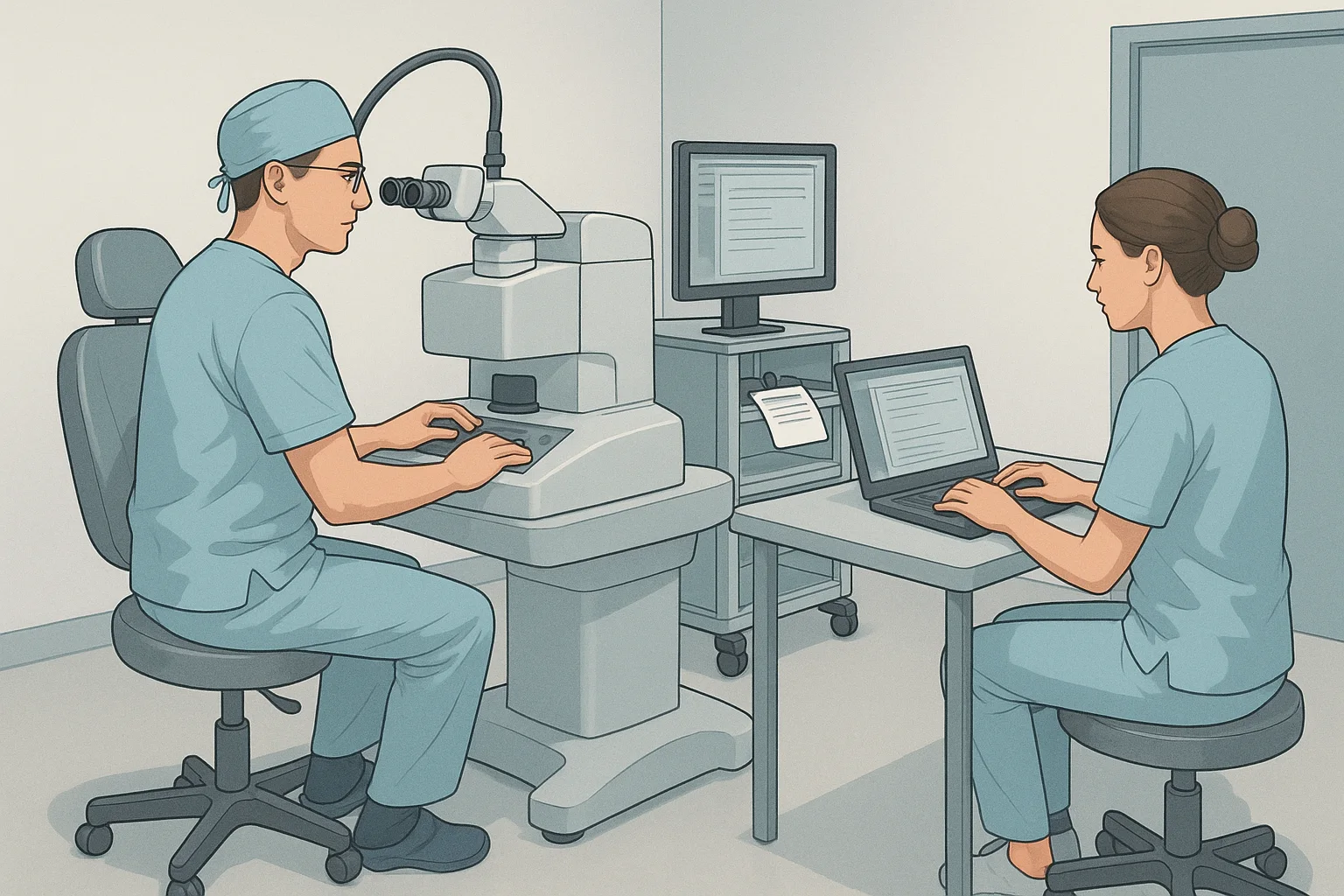
The operational answer is straightforward: do not build the pathway from a product name or from an assumed association between Nd:YAG and SLT. First confirm the functions officially documented for each device, then translate that information into scheduling, room preparation and session-record steps.
1. Separate the clinical question from the logistics question
A pathway that may accommodate several indications should distinguish two levels. The first concerns the procedure planned by the ophthalmologist. The second concerns platform organisation: assigned device, time slot, preparation, session identification and recording of relevant information. The supplied fact ledger does not describe clinical parameters or laser performance; it therefore does not support a medical comparison between Nd:YAG and SLT.
The starting point is not “which device appears versatile?” but “which function is explicitly documented for the scheduled device?”
2. Schedule from a verified function
For each session, the team can structure scheduling around a documentation check: planned indication, identified device, required function and information to be recorded. This avoids automatically attributing a function to a product when that function has not been established by the available source.
Workflow checks to include
- Identify the device selected for the session.
- Check the function corresponding to the planned procedure in the available official documentation.
- Keep scheduling information distinct from session-record information.
- Use an internal verification step when the expected function or configuration is not clearly documented.
3. Record the session without conflating product and indication
Records should link the session to the device actually used and to the planned indication, according to the facility’s internal procedures. The supplied sources do not provide a form template, laser parameters, safety protocol or regulatory content; these elements should therefore not be inferred from Cito 532, Q-Las or any other product name.
4. What the team can compare immediately
Even without detailed technical specifications, the team can compare the robustness of its pathway: clarity of the assigned device, consistency between the scheduled indication and the available documentation, separation of preparation steps, and the ability to retrieve session information. This is an organisational comparison, not a statement about the clinical effectiveness or safety of a device.
Pathway review checklist
- Is the session linked to a clearly identified device?
- Is the expected function confirmed by an official source accessible to the team?
- Does scheduling distinguish the different planned indications?
- Can the session record identify the device and function used?
- Are undocumented points flagged before the session instead of being inferred from the product name?
Share this article
Professional FAQ
Do the supplied sources prove that Cito 532 performs Nd:YAG or SLT?
No. They only show that Cito 532 is presented on a page dedicated to ophthalmology lasers. The fact ledger does not document its Nd:YAG or SLT functions.
Can the sources be used to compare Cito 532, Q-Las and COBRA?
No. The fact ledger cites Cito 532 and Q-Las but provides no comparative specifications. COBRA is not documented in the supplied sources.
What should be checked before integrating several indications into one pathway?
For each device, check the functions stated in the official documentation, then align scheduling, device identification, session traceability and the technical platform’s internal checks.