Phaco-Vitrectomy: The Functions That Matter in the Operating Room
For combined phaco-vitrectomy, platform value is not defined by the number of modules displayed on a specification sheet. It depends on whether aspiration, cutting, illumination, fluid-air exchange, silicone management and phacoemulsification work together throughout the operative sequence.
Deg umagrad-a
- 1. An architecture designed for combined procedures
- 2. Aspiration: choose system behaviour, not just a vacuum number
- 3. Posterior vitrectomy: cutting speed must serve control
- 4. Illumination: an independent function that supports visualisation
- 5. Fluid-air exchange and silicone: validate the transition functions
- 6. Phacoemulsification: extend versatility without losing precision
- 7. The decisive validation: test the console in the real operating-room workflow
For a cataract or vitreoretinal surgeon, the relevant question is not whether a console offers a long list of parameters. The question is whether its architecture follows the actual operative sequence: anterior access, phacoemulsification, possible transition towards the posterior segment, vitrectomy, membrane or tissue management, illumination, fluid-air exchange and, when required by the surgical strategy, silicone injection. This approach avoids two common errors. The first is to focus on an isolated number—cut rate, vacuum level or ultrasound power—without examining the functions that make it useful. The second is to purchase a supposedly versatile platform without checking the continuity between its modules. In combined surgery, meaningful versatility is structured versatility: every function should have a defined place in the procedure.
1. An architecture designed for combined procedures
A service combining cataract and retinal surgery needs more than a phaco console with a posterior module added afterwards. The control requirements change from one phase to the next. Phacoemulsification relies on irrigation, aspiration and ultrasound energy management. Posterior vitrectomy requires pneumatic cutting, precise vacuum control and stable visualisation. Fluid-air exchange and silicone injection introduce another pressure and workflow logic. The R-Evolution CR is positioned specifically as a platform offering options for cataract, vitreoretinal and combined procedures. That positioning is valuable only when it translates, in the selected configuration, into functions that are actually available, compatible consumables and an organisation suited to the operating room. ASEM therefore recommends validating the system through operative scenarios rather than reading the catalogue as a linear list of specifications.
2. Aspiration: choose system behaviour, not just a vacuum number
Aspiration is one of the clearest indicators of a platform’s technical maturity. Available vacuum alone does not describe system behaviour. The team must also understand how that vacuum is generated, how flow changes and how the surgeon can adjust the response during the procedure. A peristaltic pump moves fluid through mechanical rollers. It allows the team to reason in terms of both flow and vacuum, with a controlled progression linked to occlusion and the selected settings. A Venturi pump, by contrast, generates vacuum through negative pressure and follows a different response logic. Having both principles allows the aspiration strategy to be adapted to the operative phase rather than imposing one behaviour on every situation. The practical consequence is significant. The surgeon and operating-room team can build a more intelligible configuration by matching pump mode, vacuum, flow and control method to the phase of surgery. This adaptability—not numerical range alone—is what gives the aspiration architecture of the R-Evolution CR its technical interest.
3. Posterior vitrectomy: cutting speed must serve control
Vitreous cutting should be assessed with the same level of discipline. A high frequency can contribute to finer management of aspirated tissue, but its practical value depends on coordination between the guillotine, aspiration, irrigation flow, control mode and field visibility. The number alone does not describe the quality of the manoeuvre; it describes a capability that must be integrated into the surgical strategy. On the R-Evolution CR, the pneumatic posterior-vitrectomy guillotine incorporates Twedge technology and can reach 20,000 cuts per minute. Fixed or linear control through the footpedal allows the user to choose between a preset value and progressive modulation. For the team, this makes it easier to translate a protocol into usable settings: cutting is considered as part of the aspiration–cutting relationship, not as an isolated specification. This interaction is particularly relevant for a platform intended to support different procedures. The system can be assessed on its ability to move from reproducible control to more progressive modulation according to the tissue, dissection phase and surgeon’s strategy, without assigning an unsubstantiated clinical promise to cut frequency alone.
4. Illumination: an independent function that supports visualisation
In posterior surgery, illumination is not simply an accessory to the console. It contributes to field visibility and must work with the visualisation devices and the different stages of the manoeuvre. A source that can be adjusted and used coherently with the procedure gives the team useful configuration flexibility while supporting a standardised approach. The R-Evolution CR integrates three independent LED lamps, with intensity adjustment across 20 levels and four selectable colour filters. The mechanism has direct operating-room relevance: independent sources allow illumination to be treated as a configurable function, while fine intensity control and filters provide a way to adapt the lighting to the selected visualisation approach. ASEM views this independence as a major strength of the platform. It should nevertheless be assessed with the lighting accessories actually used by the team, its established visualisation habits and the procedures included in the programme. The demonstration should show not only the available intensity, but also how quickly the operator can retrieve a clear and reproducible setting.
5. Fluid-air exchange and silicone: validate the transition functions
A vitrectomy platform should not be judged only while the cutter is active. Transition phases—filling, fluid-air exchange and the management of a tamponade or silicone injection when included in the procedure—require a clear interface and appropriate parameters. They involve a different pressure logic and must be integrated into the overall workflow rather than treated as peripheral functions. The R-Evolution CR provides fluid-air exchange with an available pressure of 5–120 mmHg. It also includes a silicone oil injection function with an available pressure of 0.4–5 bar and digital sound feedback during injection. The practical value lies in having dedicated, identifiable functions within the console, to be validated in the actual room configuration. For the technical manager, the demonstration should cover operating conditions, required accessories, compressed-air supply and signalling logic. For the surgeon, it should make the transition between phases easy to follow. A convincing console maintains a consistent operative reading when the procedure changes regime.
6. Phacoemulsification: extend versatility without losing precision
In combined phaco-vitrectomy, the anterior portion should not be treated as a secondary module. Energy management, aspiration and footpedal control must remain clear because the quality of the transition between operative sequences also depends on control of phacoemulsification. The R-Evolution CR uses a piezoelectric handpiece available with four or six crystals. Ultrasound power can be controlled in fixed or linear mode through the footpedal. The system also provides continuous, pulsed and single-multiple-continuous burst ultrasound modes, together with Autolimit and HD pulse occlusion modes. The mechanism is relevant to workflow configuration. The handpiece converts electrical energy into ultrasonic movement, while fixed or linear control allows a preset level to be combined with progressive modulation. In practice, this gives the team a structured basis for setting cataract and combined procedures. The platform’s value is therefore that of a shared environment covering anterior and posterior surgery through dedicated functions rather than a succession of disconnected devices.
7. The decisive validation: test the console in the real operating-room workflow
Selecting posterior-vitrectomy and combined phaco equipment should not end when the supplier confirms that the required functions exist. ASEM recommends a demonstration built around the procedures planned by the facility: select the pump, set vacuum and flow, move to vitreous cutting, adapt illumination, activate fluid-air exchange and verify the silicone function when it belongs to the programme. The footpedal deserves particular attention. It concentrates a significant part of operative control and should allow the team to understand the relationship between fixed and linear control, aspiration, cutting and energy. Interface readability, alert logic, access to settings and consumable preparation should all be observed within the same scenario. This method is equally useful for the technical manager. It distinguishes the platform’s theoretical capabilities from the requirements of integration: power supply, compressed air, accessories, maintenance, training and stock organisation. System performance in the operating room always depends on this complete chain. The World Health Organization’s quality-of-care framework for cataract surgery likewise addresses preoperative, intraoperative and postoperative phases, reinforcing the importance of evaluating equipment as part of the wider care process rather than as an isolated purchase.
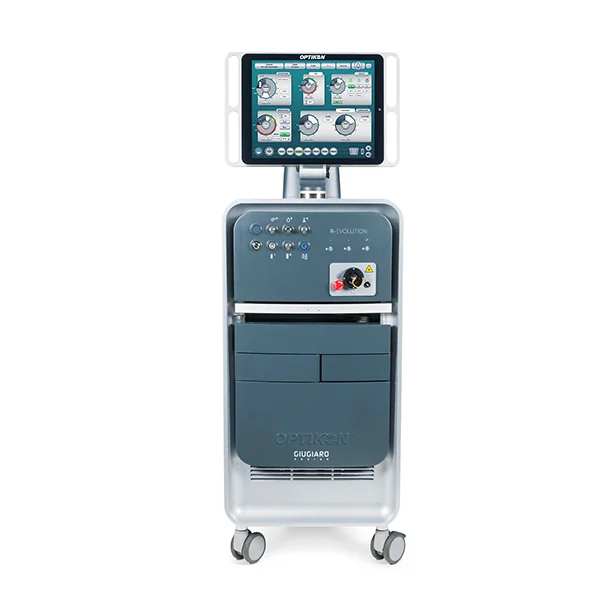
Cataract surgery, vitrectomy and combined interventions do not mobilise the same functions at the same moment. The right question is therefore not, “How many parameters does the console offer?” but, “How do its functions work together when the procedure changes phase?” The R-Evolution CR provides a structured answer: two aspiration principles, pneumatic vitrectomy with a high cutting frequency, independent LED illumination, fluid-air exchange, silicone oil injection and piezoelectric phacoemulsification. Each module responds to an identifiable operative stage; their combination gives the platform its relevance for a phaco-vitrectomy programme. In an environment where quality of care must be considered across preoperative, intraoperative and postoperative phases, equipment cannot be selected as a simple budget line. It must be matched to the protocol, team, accessories and maintenance plan. That complete reading is what turns technical capability into an operating-room solution.
Bḍu amagrad-a
Isteqsiyen imahlanen
Which functions should be checked first for combined phaco-vitrectomy?
Assess the coherence between aspiration, irrigation, vitreous cutting, illumination, fluid-air exchange, silicone management and phacoemulsification. The key is to validate each operative sequence and the transitions between them.
What is the value of having both peristaltic and Venturi pumps?
The two aspiration principles allow the system’s behaviour to be adapted to different surgical situations. A peristaltic pump links flow and vacuum in a controllable way, while Venturi aspiration generates vacuum directly through negative pressure.
Is the R-Evolution CR intended only for vitrectomy?
No. The R-Evolution CR is presented as a platform offering options for cataract, vitreoretinal and combined procedures, with dedicated phacoemulsification and vitrectomy functions.
Why should illumination be assessed as a system function?
Illumination contributes to field visibility and must fit the visualisation strategy, probes and stages of posterior surgery. An independent, adjustable source gives the team a practical way to adapt the lighting configuration.
Tiɣbula d yimsisɣalen
Institutional Source
-
BVI Medical – R-Evolution® CR
BVI Medical · R-Evolution CR · www.bvimedical.com
Tettwaseqdec 2026-11-29 -
Blindness and vision impairment
BVI Medical · R-Evolution CR · www.who.int
Tettwaseqdec 2026-08-09 -
Summary of recommendations for quality of care in cataract surgery management
BVI Medical · R-Evolution CR · www.who.int
Tettwaseqdec 2026-08-09
Scientific Document
-
www.bvimedical.com
BVI Medical · R-Evolution CR · www.bvimedical.com
Tettwaseqdec 2026-11-29
Tidyanin icudden ɣer usentel-a

Special Focus Meeting 2027 - Inherited Retinal Diseases
Ljubljana, SluviniyaEURETINA
A professional ophthalmology event organised by EURETINA. Please consult the official source for the lates...
31st ESCRS Winter Meeting
Le Caire, MiṣṛEuropean Society of Cataract and Refractive Surgeons
A professional ophthalmology event organised by European Society of Cataract and Refractive Surgeons. Plea...
ASCRS Annual Meeting 2027
San Diego, ImeṛṛikanAmerican Society of Cataract and Refractive Surgery
A professional ophthalmology event organised by American Society of Cataract and Refractive Surgery. Pleas...