Rotary or Sliding: Which Refraction Unit Table Fits Your Practice?
Choosing between a rotary and sliding table is not a matter of mechanical preference alone. It shapes instrument access, refraction workflow, patient positioning and circulation around the examination chair.
Deg umagrad-a
- The rotary table: changing the working orientation around the patient
- The sliding table: prioritising a clear, linear path
- The decisive criterion is the examination sequence—not the movement in isolation
- Height, chair and tabletop: one ergonomic architecture
- Instruments, storage and cable routing: the details that determine daily usability
- The F.I.S.O. approach: treat the workstation as a system
- How to make the decision in a multifunctional practice
In a multifunctional refraction unit, the table mechanism becomes immediately relevant as soon as the examination involves several instruments. The practitioner may alternate between observation, subjective refraction, visual acuity checks and complementary examination, while the patient must remain correctly positioned and the operator must preserve a stable, repeatable posture. A rotary table and a sliding table therefore create different working environments. Each imposes a different way of organising the chair, instruments, controls and movement through the room.
ASEM’s position is straightforward: do not select a movement based on its name alone. Compare the mechanism with the real examination sequence, room layout, user profile and instrument configuration. That whole-system assessment is what separates a genuinely functional refraction station from a well-equipped workstation that is difficult to use efficiently.
The rotary table: changing the working orientation around the patient
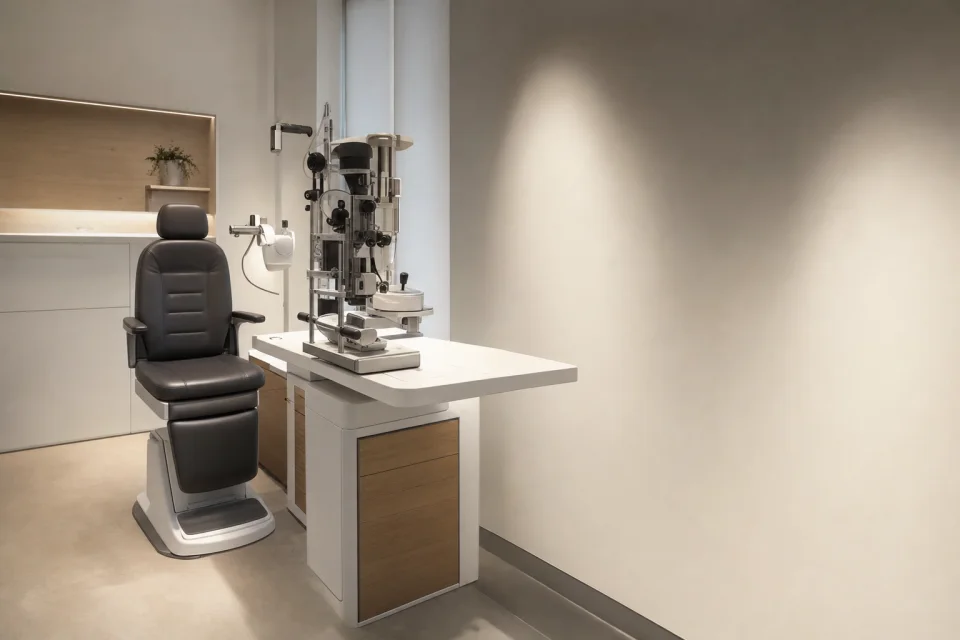
A rotary table uses angular movement of the tabletop or instrument assembly around an axis. Mechanically, the system converts a series of orientation changes into one controlled movement. Its technical interest becomes clear when instruments are arranged around the patient and the practitioner needs to move from one to another without reorganising the room or repeatedly changing position.
This architecture can reduce lateral repositioning by the operator. Instead of walking or reaching around the chair, the practitioner brings the selected instrument into the working zone. The practical benefit depends on the rotation radius, chair position, available clearance and the way cables follow the movement. Effective rotation therefore requires a clean installation and sufficient free space around the station.
The main operational strength is continuity of orientation. In a sequence where several instruments must be presented successively along the patient’s visual axis, rotation can make transitions more natural. It does not replace a well-defined examination method, but it can support a workflow in which the examiner maintains a reference position and brings the required instrument into that position.
The sliding table: prioritising a clear, linear path
A sliding table is based on guided translation. The tabletop or instrument module moves along a linear path, creating a direct spatial relationship between its starting and finishing positions. This logic can be particularly appropriate when the room has a clear circulation axis or when the practitioner wants the material’s position to remain immediately understandable to the whole team.
Translation answers a different requirement from rotation. It does not primarily present the instrument at a new angle; it moves the module through a defined corridor. The practical consequence may be a more predictable trajectory during patient changeover, cleaning or restoration of the workstation to its initial position.
A sliding architecture does, however, require a precise assessment of room depth. The travel must remain compatible with the chair, walls, storage units and circulation area. If the stroke is poorly integrated into the floor plan, translation may simply relocate the space constraint rather than resolve it. Guiding quality and structural stability matter, but so does the way the travel is incorporated into the room.
The decisive criterion is the examination sequence—not the movement in isolation
The decision becomes more rational when it is mapped against the actual workflow. Start by listing the stages performed at the station: patient positioning, measurement or refraction, instrument change, observation, storage and patient exit. For each stage, observe hand position, line of sight, trunk rotation and whether the practitioner needs to stand or change sides.
A rotary table may be coherent with an examination in which instrument orientation changes frequently and is central to the workflow. A sliding table may fit a room organised around a longitudinal axis where predictable linear movement is the priority. In both cases, the value does not come from the mechanism in abstraction. It comes from the match between the movement, the instrument layout and the examiner’s method.
Height, chair and tabletop: one ergonomic architecture
Table height should never be assessed independently of the chair. The chair establishes the patient’s position; the tabletop determines how instruments are presented; and the user determines the working eye level, shoulder position and distance from the patient. A coherent configuration keeps these three elements in a stable relationship throughout the examination sequence.
A height-adjustable table may offer a broader range of adaptation, but any additional mechanical function must be assessed for stability, control, travel and compatibility with the installed instruments. A fixed-height table can be entirely appropriate when the chair and workstation have been defined accurately. The essential point is to avoid compensatory postures: if the practitioner repeatedly raises the shoulders or leans towards the patient, the underlying issue may concern the overall architecture rather than one isolated component.
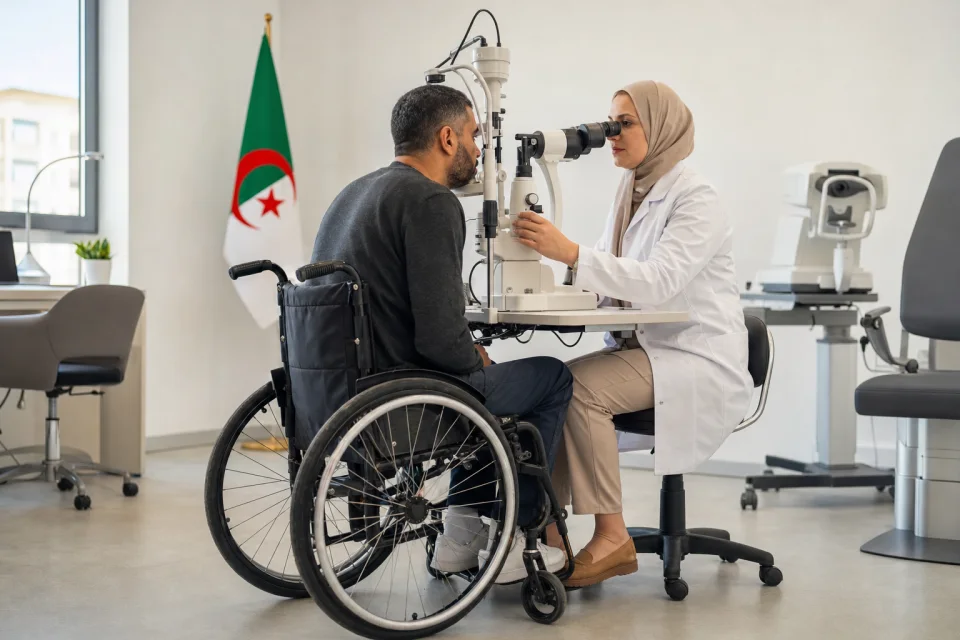
The chair must also support safe patient entry and exit without forcing the patient or practitioner to manoeuvre around the tabletop. For practices receiving patients with reduced mobility, accessibility must be incorporated into the circulation plan, with appropriate clearances and a safe approach to the chair. Table mechanics cannot be separated from this practical requirement.
Instruments, storage and cable routing: the details that determine daily usability
A table can be mechanically elegant and still be inconvenient if instruments, controls and accessories are not positioned correctly. The working principle is simple: every item used during the sequence should be reachable without creating a postural interruption. Less frequently used accessories can remain protected and stored, while frequently used items should be immediately available without overcrowding the work surface.
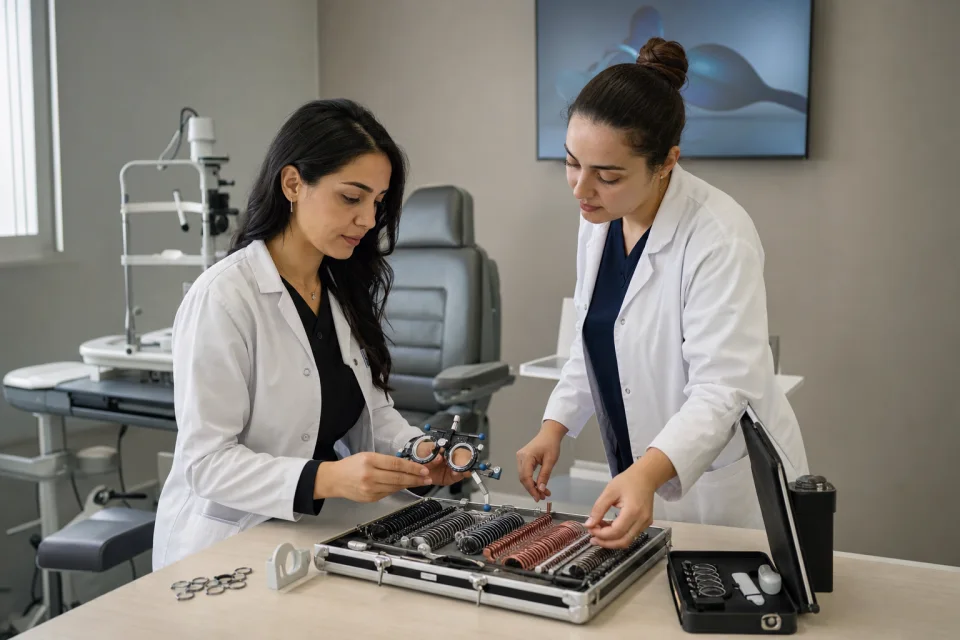
Storage also contributes to workflow continuity. F.I.S.O. indicates that most of its ophthalmic units include a foldaway anti-dust drawer for the ophthalmoscope and skiascope, while some models include a dedicated trial-lens drawer positioned for user comfort. These features can reduce visible clutter and protect accessories between examination sequences. Their presence and exact arrangement must be confirmed for the specific reference selected.
The F.I.S.O. approach: treat the workstation as a system
F.I.S.O. presents its refraction units through several complementary dimensions: functionality, ergonomics, comfort, design and technical characteristics. That approach is relevant to a multifunctional practice because a refraction unit is more than a tabletop. It must accommodate instruments, support repeated working postures, maintain a professional presentation and integrate with the chair and surrounding furniture.
Chair compatibility deserves particular attention. F.I.S.O. states that its refraction units can be equipped with the company’s ophthalmic chair range, available with several upholstery colours. Most models are also available in a left-handed version, according to the manufacturer. These points support a configuration-led approach, particularly where several practitioners share the room or the layout must be adapted to different working positions. They should nevertheless be confirmed for the exact model and option set.
How to make the decision in a multifunctional practice
Prioritise these criteria
- The dominant trajectory: rotation around the patient or translation along a defined axis.
- The practitioner’s usual position and whether the examination requires a change of side.
- The actual room width and depth, including doors, furniture and storage.
- The relationship between chair height, tabletop height and the optical axis of the instruments.
- The location of drawers, accessories, controls and cable routes.
- Whether a left-handed configuration or shared use by several practitioners is required.
- Chassis stability, guide quality and the simplicity of returning the unit to its working position.
- Availability of manuals, technical documentation and certificates for the exact reference.
It is also important to distinguish an ergonomic promise from a demonstrated use case. A rotary architecture may facilitate an instrument transition; a sliding architecture may clarify a movement path. Neither guarantees better practice by itself. Value appears when the movement is stable, predictable, compatible with the chair, accessible to the user and properly adapted to the room.
The best table is not the one offering the most movement, but the one that turns the examination sequence into short, clear and reproducible actions.
For ophthalmologists and practice managers in Algeria, the choice should therefore be treated as a room-planning and workflow decision, not simply as a catalogue comparison. The workstation must be assessed with its chair, instruments, users and examination rhythm. Only then can a rotary, sliding or height-related architecture become a genuine organisational asset.
Bḍu amagrad-a
Isteqsiyen imahlanen
Is a rotary table always more ergonomic than a sliding table?
No. Rotation can make it easier to orient an instrument, while translation can provide a more predictable linear path. Ergonomics depends on the examination sequence, available space, practitioner position and instrument layout.
Which table is best for a narrow refraction room?
Assess the real footprint of the table, the chair’s trajectory, lateral clearances and cable routing. A sliding architecture may suit a room organised around a longitudinal axis, while a rotary architecture may be preferable when instrument orientation around the patient is the priority. The final decision requires an on-site or plan-based configuration review.
Is a height-adjustable table essential?
Not necessarily. The decision depends on user morphology, the chair, working position and instruments installed. Table height should be assessed as part of the complete workstation, not as an isolated specification.
What should be checked before ordering a refraction unit?
Confirm the exact reference, instrument capacity, movement type, included accessories, chair compatibility, left-handed availability, usable dimensions and the technical documentation associated with that reference.
Tiɣbula d yimsisɣalen
Akatalug unṣib
-
FISSO medical product downloads
F.I.S.O. · fisso.com
Tettwaseqdec 2026-10-14 -
F.I.S.O. refraction units
F.I.S.O. · www.fiso.info
Tettwaseqdec 2026-11-18
Tidyanin icudden ɣer usentel-a

31st ESCRS Winter Meeting
Le Caire, MiṣṛEuropean Society of Cataract and Refractive Surgeons
A professional ophthalmology event organised by European Society of Cataract and Refractive Surgeons. Plea...
ASCRS Annual Meeting 2027
San Diego, ImeṛṛikanAmerican Society of Cataract and Refractive Surgery
A professional ophthalmology event organised by American Society of Cataract and Refractive Surgery. Pleas...
39th APACRS Annual Meeting
Bali, IndunizyaAsia-Pacific Association of Cataract & Refractive Surgeons
A professional ophthalmology event organised by Asia-Pacific Association of Cataract & Refractive Surgeons...