Ergonomics
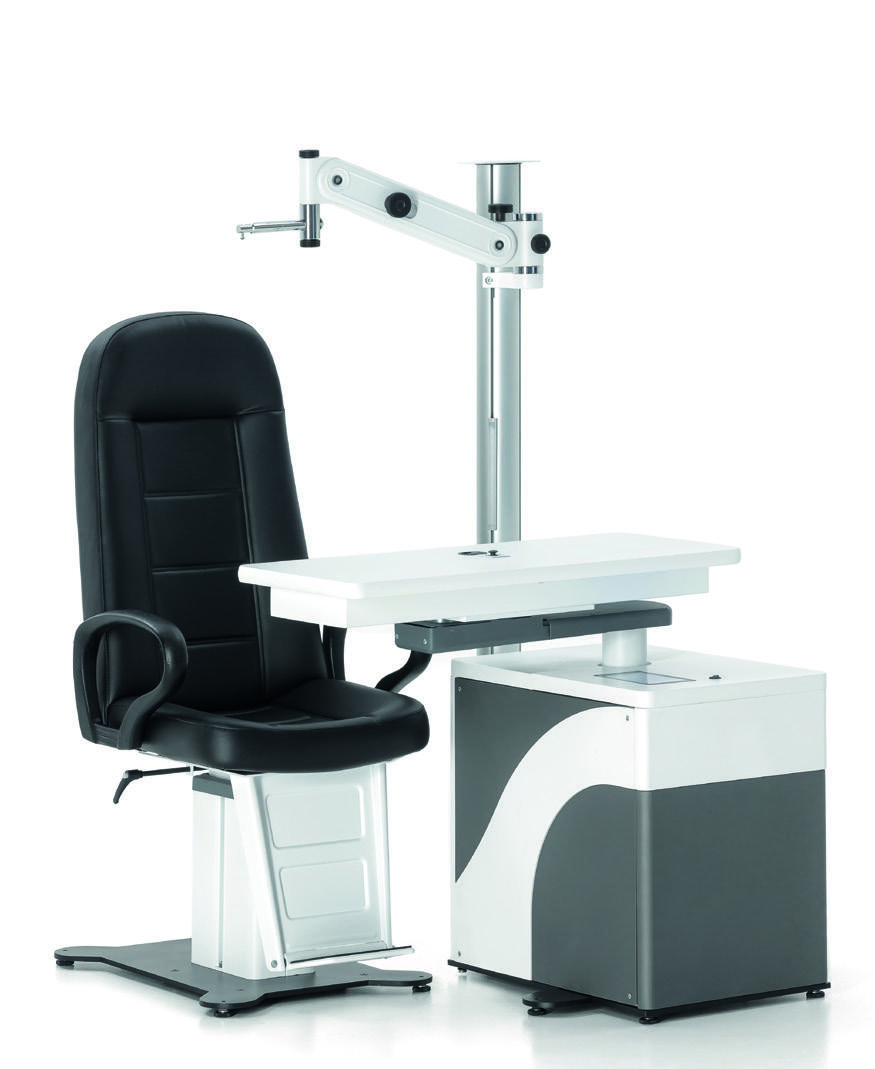
A layout designed around the consultation station.
An ergonomic refraction station organising instruments, patient and practitioner.
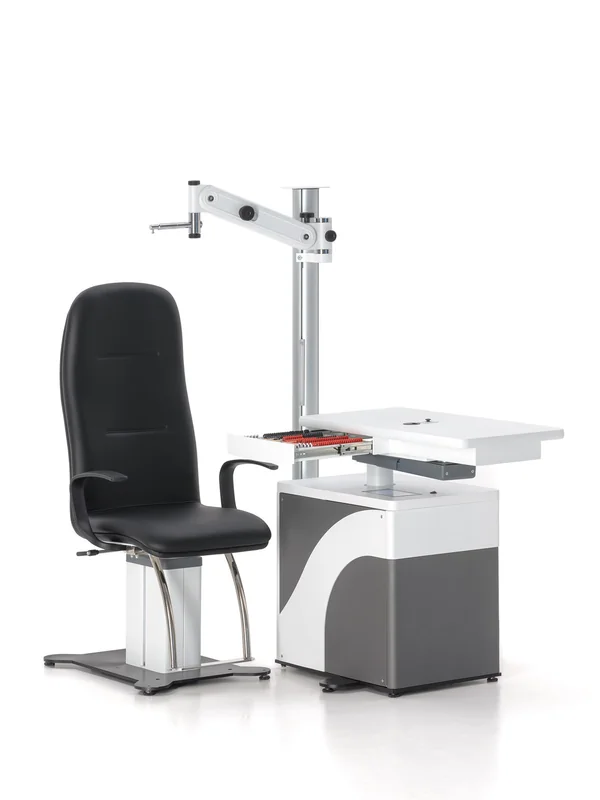
A layout designed around the consultation station.
Equipment has its place on a dedicated unit.
Available movements facilitate configuration adjustment.
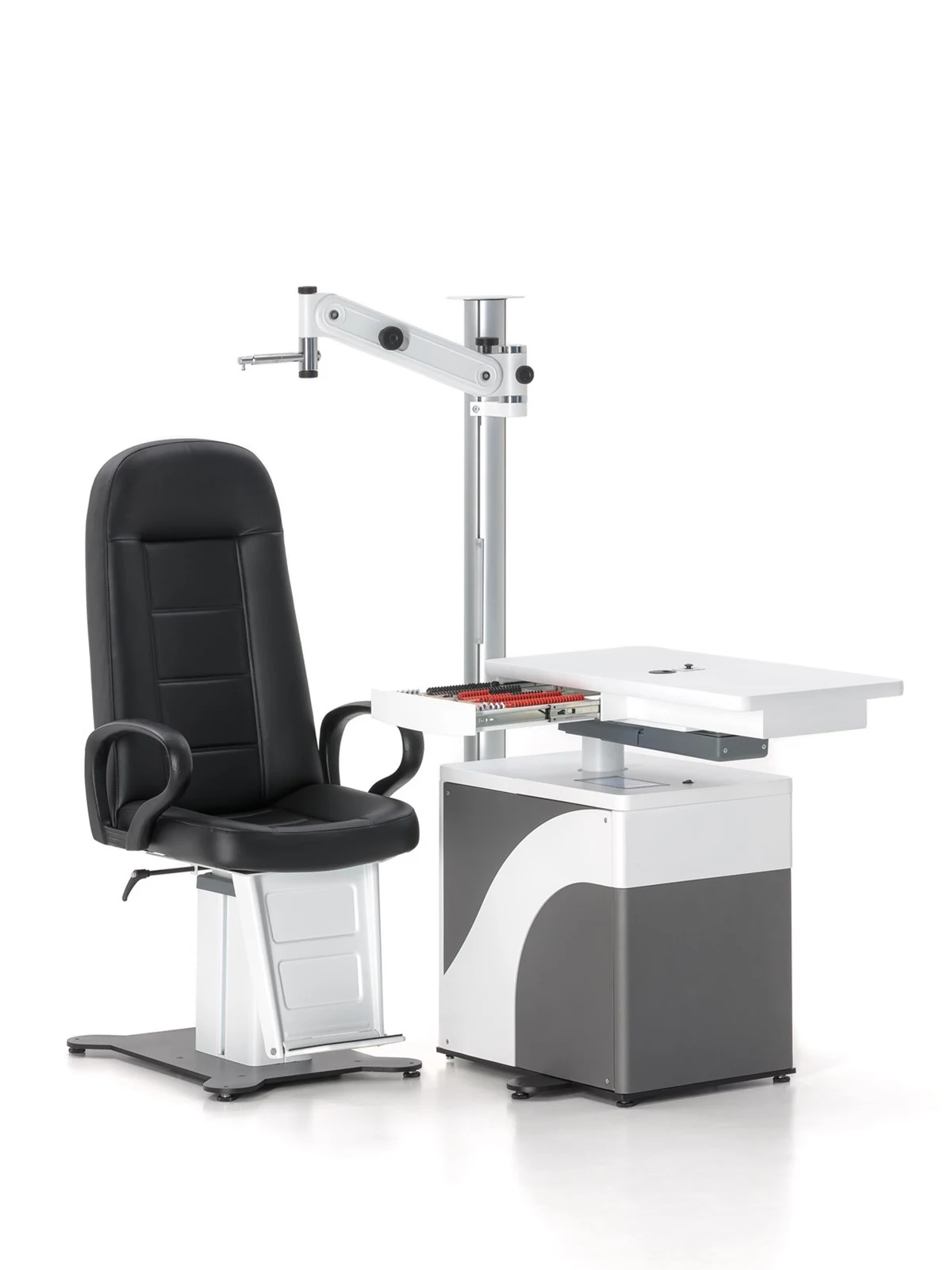
The manufacturer view shows the exact station configuration and access to instruments.
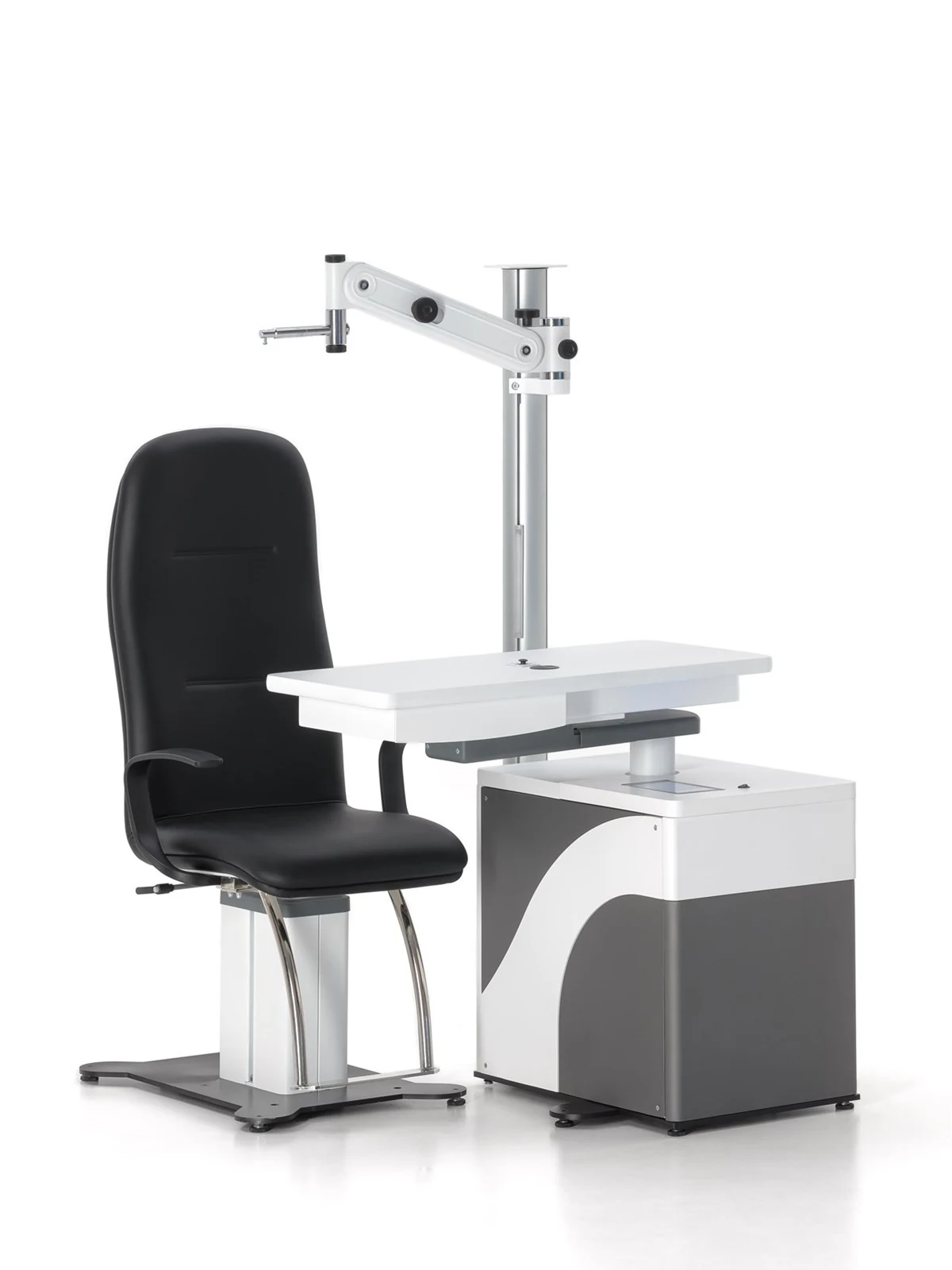
The documented worktop movement supports switching between instruments on Easyvisus RM64 Compact — 2 instruments.
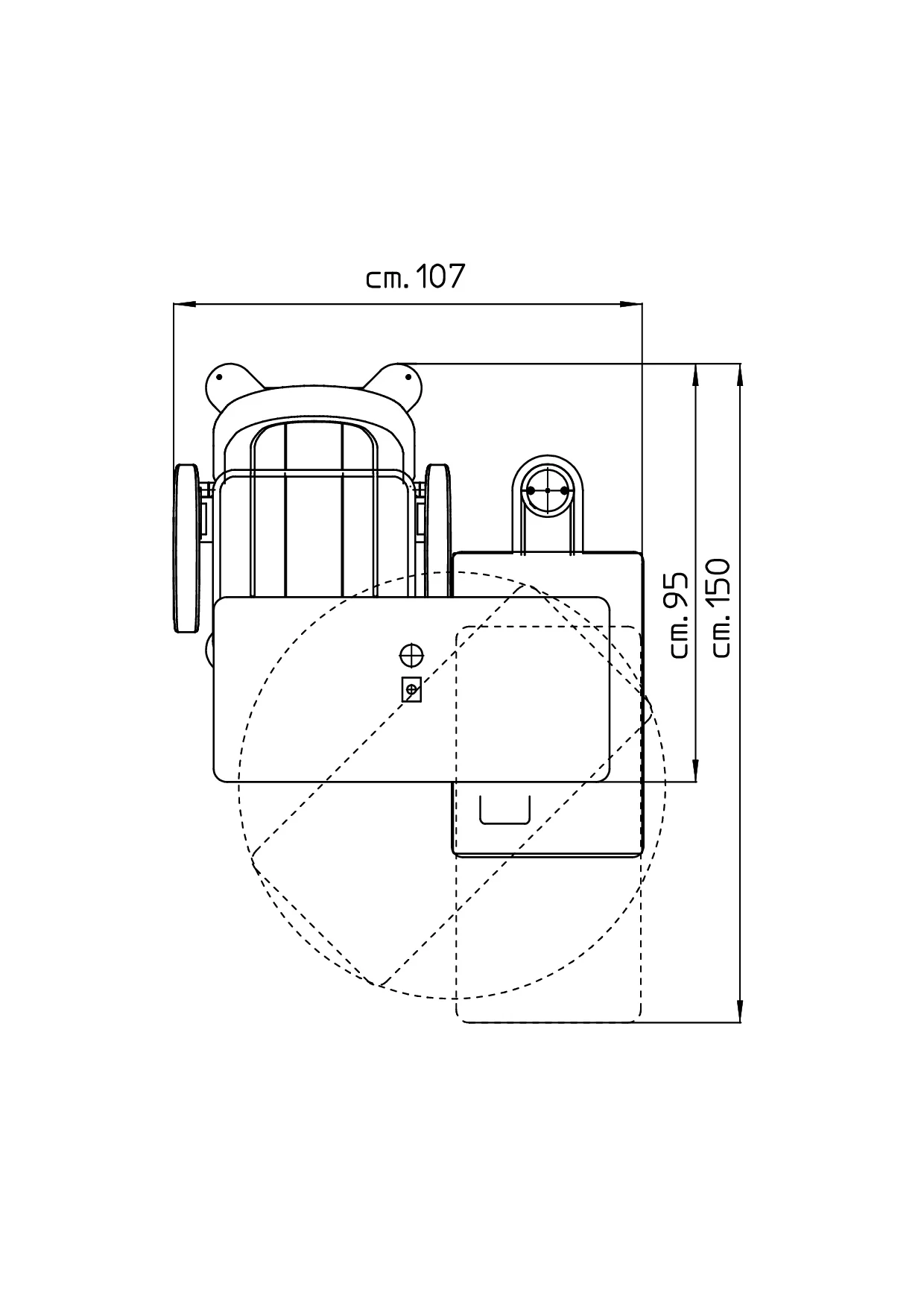
The official diagram documents the footprint and supports Easyvisus RM64 Compact — 2 instruments installation planning.
The two-instrument Easyvisus RM64 Compact has an electrically height-adjustable table. The range offers rotation, manual sliding or electric sliding, with a table drawer in one specific configuration. It retains the LCD panel, joystick and electric PRIMA chair without the separate 236-lens desk tray of non-Compact RM64 units. The appropriate practice configuration must be confirmed with ASEM.
400900 and 400930 are rotating versions; only 400930 has the drawer with a wooden tray for 148 trial lenses. 400950 uses manual sliding and 400955 electric sliding. All have electric table height adjustment. The manufacturer specifies a minimum table height of 76 cm and opening for examination of a wheelchair user. The lens set must be specified, and this minimum does not describe overall unit height.
The LCD panel supports a custom logo. The joystick controls chair and table up/down movement and locking. The manufacturer documents electromagnetic locking of the rotating table and table arm. Electric height adjustment is distinct from the rotation or sliding mode selected for the reference.
The standard PRIMA has electric height adjustment and black skai upholstery without a footrest. A tip-up footrest, other coverings and replacement with another chair model are documented options. Chair versions must be confirmed in the ASEM quotation. Original photographs may show a footrest, phoropter arm or other optional accessories; visibility does not establish inclusion. Illustrated instruments and accessories must be identified separately.
The aluminium pole has dimmable ambient LED lighting, an LED reading light and a chart projector support plate. The main unit includes power supply for the slit-lamp transformer. The painted steel base has adjustable feet. Additional instrument power supplies are listed as accessories and are not assumed to be included automatically. No complete-unit input voltage or frequency is extrapolated.
Electric sliding reference 400955 is right-handed only. The other configurations have optional left-handed 400900S, 400930S and 400950S versions. The separate 236-lens desk drawer of non-Compact RM64 units is not standard equipment for this version. Rotating and sliding footprints differ. No weight, frequency or maximum height is invented; movement clearance must be checked with ASEM.
Easyvisus — catalogue fabricant 2025, anglais (PDF · 68 pages)
The setup remains coherent.
Equipment is organised in one place.
The station adapts to the examination.
The team works in a structured space.
Asmekti yemṣadan d wayen teḥwaǧeḍ.
Asebded d uselmed akked terbaɛt.
Tallalt tatiknikant n tama mi ara tt-teḥwaǧeḍ.
Tallalt i d-yedduyen i useqdec n tifrat.
Asnas ASEM
Iferdisen, isumar, tifaturin d SAV deg ufus-ik.
Amezwaru deg Lezzayer


An ergonomic refraction station organising instruments, patient and practitioner.
A layout designed around the consultation station.
Equipment has its place on a dedicated unit.
Available movements facilitate configuration adjustment.
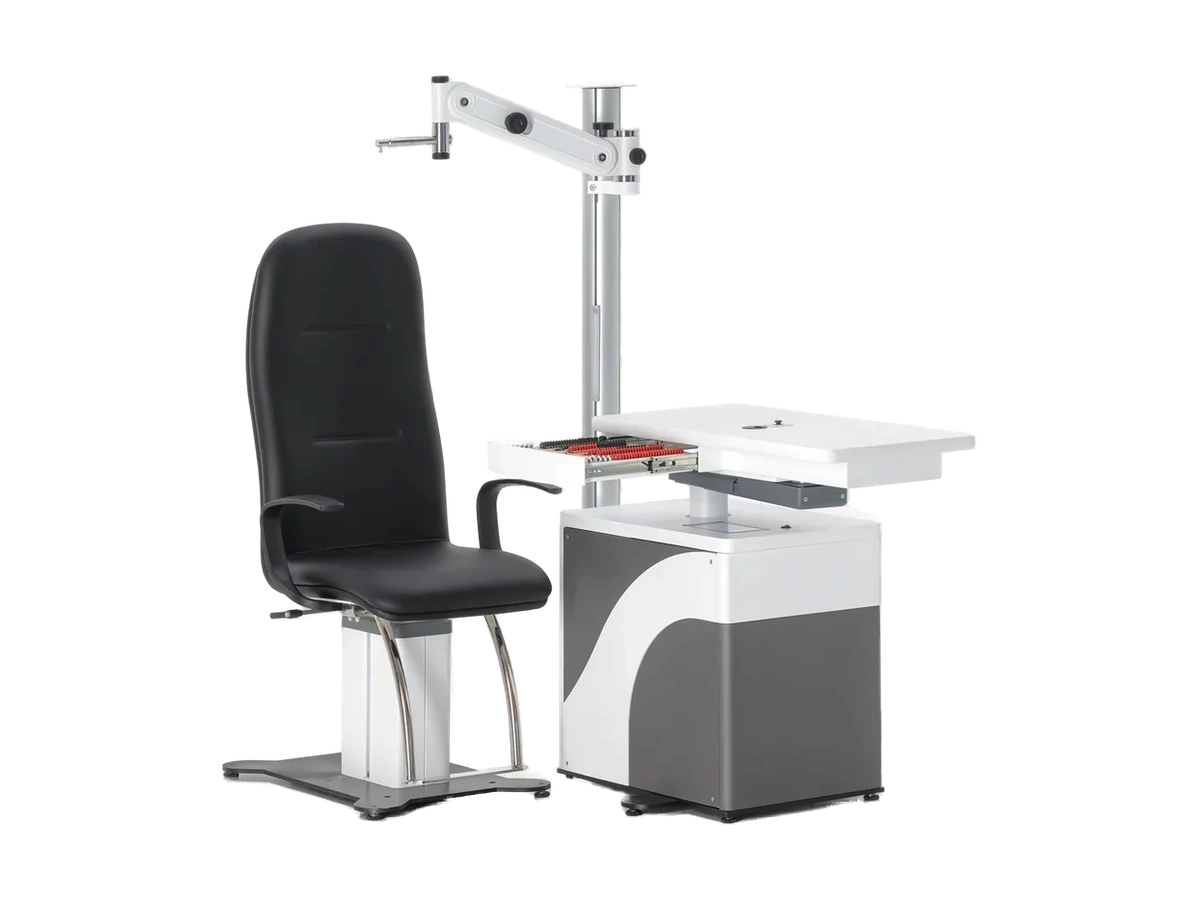
The manufacturer view shows the exact station configuration and access to instruments.
The documented worktop movement supports switching between instruments on Easyvisus RM64 Compact — 2 instruments.
The official diagram documents the footprint and supports Easyvisus RM64 Compact — 2 instruments installation planning.
The two-instrument Easyvisus RM64 Compact has an electrically height-adjustable table. The range offers rotation, manual sliding or electric sliding, with a table drawer in one specific configuration. It retains the LCD panel, joystick and electric PRIMA chair without the separate 236-lens desk tray of non-Compact RM64 units. The appropriate practice configuration must be confirmed with ASEM.
400900 and 400930 are rotating versions; only 400930 has the drawer with a wooden tray for 148 trial lenses. 400950 uses manual sliding and 400955 electric sliding. All have electric table height adjustment. The manufacturer specifies a minimum table height of 76 cm and opening for examination of a wheelchair user. The lens set must be specified, and this minimum does not describe overall unit height.
The LCD panel supports a custom logo. The joystick controls chair and table up/down movement and locking. The manufacturer documents electromagnetic locking of the rotating table and table arm. Electric height adjustment is distinct from the rotation or sliding mode selected for the reference.
The standard PRIMA has electric height adjustment and black skai upholstery without a footrest. A tip-up footrest, other coverings and replacement with another chair model are documented options. Chair versions must be confirmed in the ASEM quotation. Original photographs may show a footrest, phoropter arm or other optional accessories; visibility does not establish inclusion. Illustrated instruments and accessories must be identified separately.
The aluminium pole has dimmable ambient LED lighting, an LED reading light and a chart projector support plate. The main unit includes power supply for the slit-lamp transformer. The painted steel base has adjustable feet. Additional instrument power supplies are listed as accessories and are not assumed to be included automatically. No complete-unit input voltage or frequency is extrapolated.
Electric sliding reference 400955 is right-handed only. The other configurations have optional left-handed 400900S, 400930S and 400950S versions. The separate 236-lens desk drawer of non-Compact RM64 units is not standard equipment for this version. Rotating and sliding footprints differ. No weight, frequency or maximum height is invented; movement clearance must be checked with ASEM.
Easyvisus — catalogue fabricant 2025, anglais (PDF · 68 pages)
The setup remains coherent.
Equipment is organised in one place.
The station adapts to the examination.
The team works in a structured space.
Asumer yemṣadan akked tuddsa-ik d yisra-ik.
Asebded akked uselmed s yidwen n terbaɛt ASEM.
Tallelt tatiknikant n tama deffir usebded.
Tallelt tkemmelt akken ad tesqedceḍ tifrat deg wakud.
Asnas ASEM
Wali ugar n tnumiwin, suter isumar-ik n ssuma, wali tifaturin-ik, u nermes tallelt seld uznuz srid seg tilifun-ik.
Amezwaru deg Lezzayer i yimseḍfaren n tdawsa.Akatalug, isumar n ssuma, tifaturin d tuttriwin n tallelt seld uznuz, akk deg usnas n ASEM.
