
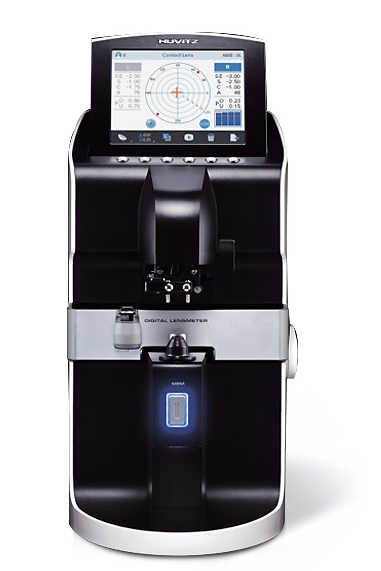
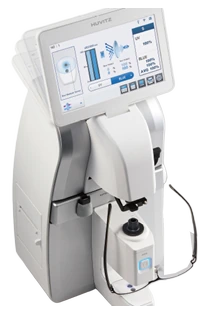
HLM-7000P
Spectacle and contact lens measurement.
Automatic measurements. UV transmittance measurement. Pupillary distance. Tilting LCD screen. Multifocal, tinted and high-power lenses.
Key advantages
The documented strengths of HLM-7000P, at a glance.
Spectacle lens measurement
Sphere, cylinder and prism power measurement.
Contact lenses
Measurement of rigid and soft contact lenses.
Wide optical range
Sphere from −25 to +25 D; cylinder up to 10 D.
Capabilities in practice
A closer look at the functions and technology of HLM-7000P.
Different lens formats
HLM-7000P accepts lens diameters from 15 to 120 mm. Its prism range reaches 20 Δ in base-up, base-down, base-in and base-out directions.
- Lens diameter from 15 to 120 mm.
- Prism up to 20 Δ in all four base directions.
Examine deeply tinted lenses
The device adapts illumination when measuring sunglasses and mirror-coated lenses.
- Automatic light amplification.
- Hartmann wavefront-sensor analysis.
Designed for a smoother workflow
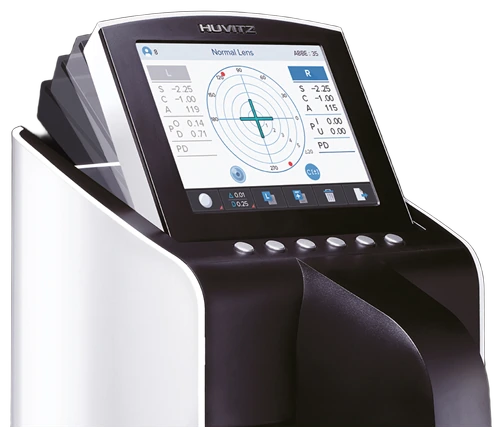
Guide progressive-lens measurement
Interface guidance supports distance and near measurements. The PD bar and measurement nose help position small and multifocal lenses.
- Progressive-lens recognition and guidance.
- Distance, near and addition measurements.
Follow the lens markers on screen
The IPS screen presents positioning and results in the measuring interface.
- 5.7-inch colour screen.
- Brightness adjustment and anti-glare treatment.
Product gallery
Designed for daily practice
Explore the documented features and practical configuration of HLM-7000P.
Read UV transmission
UV mode presents a transmittance value and graph. Light amplification is provided when measuring dark-tinted or mirrored sunglasses.
- Numerical and graphical UV result.
- Measurement of ordinary lenses and sunglasses.
Keep reference marks on the printout
The thermal printer produces results and their graphical indications.
- Axis and pupillary-distance illustrations.
- One-touch paper replacement.
More product details
Micrometric contact lens measurements
Dedicated modes for different lens types. Hartmann wavefront analysis supports measurement precision.
HLM-7000P Digital lensmeter
Measurement ranges Spherical power: 0~±25.00D. Cylindrical power: 0~±10.00D. Cylinder axis: 0°~180° (1° increments). Addition power: 0~+10D. Prismatic power: 0~20Δ.
Technical information
Technical specifications & documentation
Product information, specifications and available documentation in one place.
Product specifications overview
Key documented information for this exact model.
Technical specifications
- Minimum sphere
- -25 D
- Maximum sphere
- 25 D
- Maximum cylinder
- 10 D
- Maximum prism
- 20 Δ
- Connectivity
- RS-232C
- Power supply
- 100–120 or 220–240 V AC; 50–60 Hz
- Dimensions
- 190 × 237 × 377 mm
- Weight
- 5.5 kg
Downloads & resources
Available product sheets and public manufacturer resources.
No public manufacturer document has been verified for this model. Contact ASEM for the available documentation.
Sources and documentation
- https://huvitz.com/wp-content/uploads/2024/11/HLM-7000P_6p_eng_20171207.pdfVerified on 2026-10-05
- https://huvitz.com/wp-content/uploads/2024/11/HLM-7000P_6p_eng_20171207.pdfVerified on 2026-10-18
Frequently asked questions
Your questions about HLM-7000P
Clear answers based on the available product information.

What is the documented Minimum sphere of HLM-7000P?
-25 D
View sourceWhat is the documented Maximum sphere of HLM-7000P?
25 D
View sourceIs a separate UV tester required?
UV measurement is integrated into HLM-7000P. The screen presents a numerical value and chart for the measured lens, including sunglasses.
View sourceWhich lens diameters are specified?
The brochure specifies a 15–120 mm range. Mode selection and lens positioning form part of the measurement procedure.
View sourceDoes HLM-7000P measure prism?
Yes. The stated range reaches 20 Δ, with base-up, base-down, base-in and base-out presentation.
View sourceASEM support
More than a device, a long-term partnership
Discuss your project with ASEM: equipment selection, installation, training and technical support.
Installation
Discuss the installation requirements and configuration with our technical team.
Learn more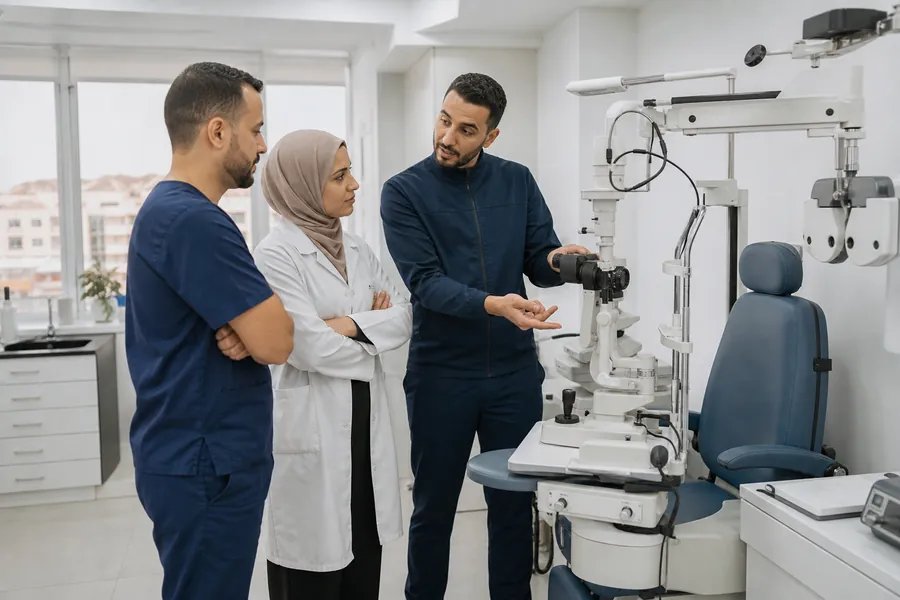

After-sales service
Contact ASEM for technical assistance and the support appropriate to your equipment.
Learn more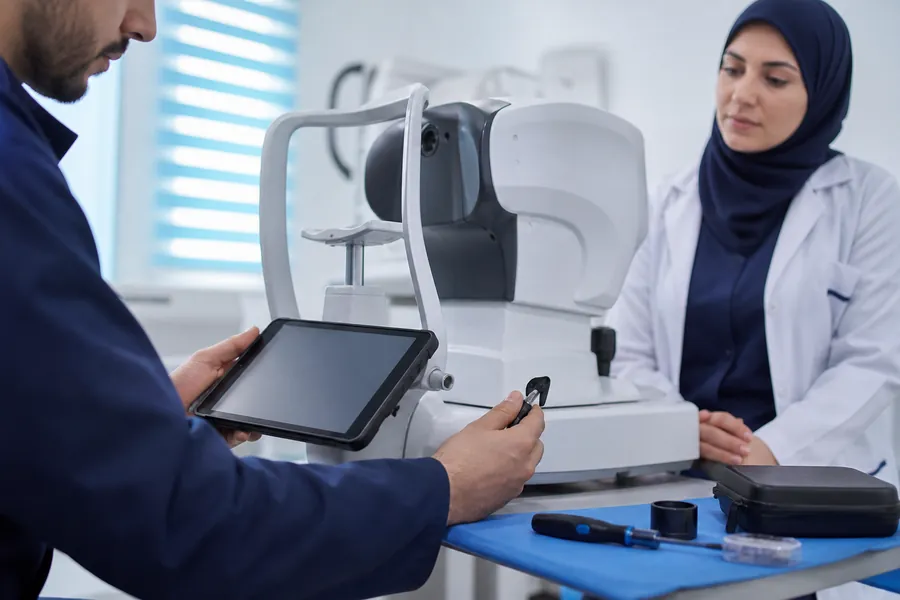

Related products
Explore equipment with related technologies and clinical uses.
Clinical applications
Explore the ASEM clinical catalogue
Browse related areas of the ASEM catalogue. These links do not extend the indications of this device.
Explore all products