Two Instruments, One More Fluid Ophthalmic Workflow
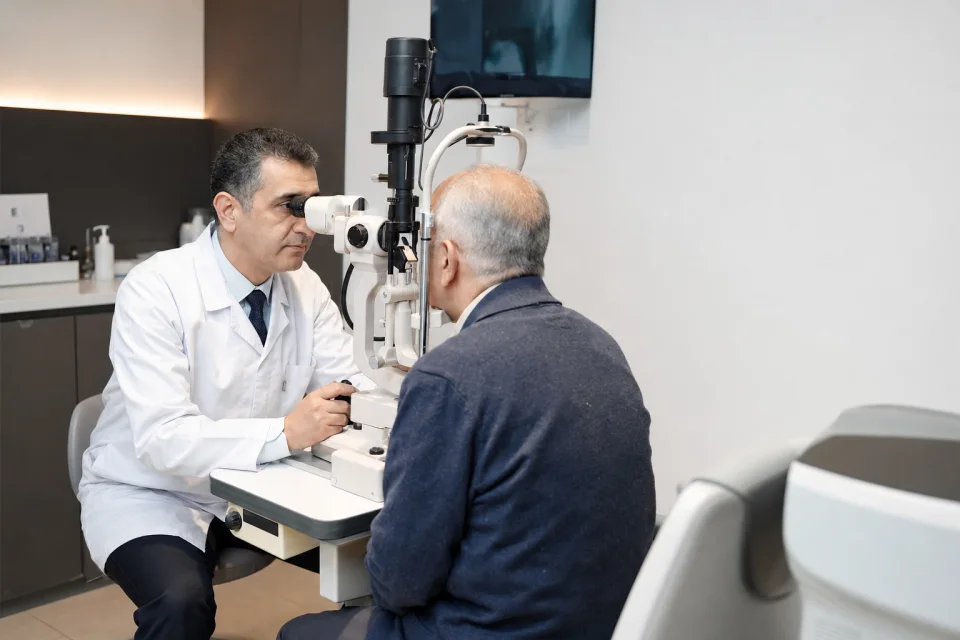
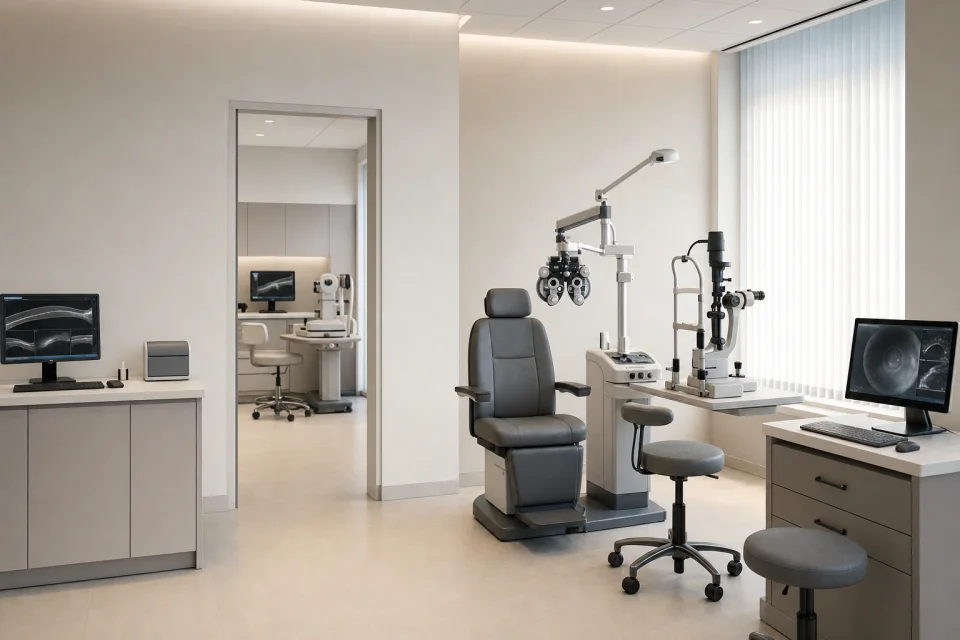
When two instruments must remain available within the same examination area, workflow quality depends on more than equipment capacity. A coherent refraction unit can support stable organisation, ergonomic access, repeatable routines and a clearer patient journey.
In this article
- Easyvisus MS33 — 2 instruments: a concrete starting point for workflow design
- Map the patient journey before finalising the installation
- Steel and wood: a technical foundation for a repeatedly used workstation
- Storage: making the right accessory available at the right moment
- Ergonomics means coordinating three users: patient, practitioner and assistant
- Plan for every practitioner who will use the room
- Why a dedicated unit is stronger than an improvised assembly
- A professional equipment decision should be prepared on site
In an ophthalmology practice, workflow rarely deteriorates because of one dramatic failure. It is usually weakened by small interruptions: the patient has to be repositioned, an instrument is not immediately available, an accessory has been left on another surface, the practitioner leaves the examination axis or the assistant has to interrupt another task. Each event may appear minor. Repeated throughout a working day, however, these micro-disruptions affect examination continuity, staff coordination and the patient’s perception of the practice.
ASEM approaches this issue as a workstation-architecture question. When two instruments are involved, the objective is not merely to fit them into the same room. The objective is to organise a coherent sequence: patient arrival, seating, measurement or observation, transition between stages, interaction with the patient and clinical communication. The workstation should support this sequence without requiring constant reconfiguration of the room.
Easyvisus MS33 — 2 instruments: a concrete starting point for workflow design
This is where the Easyvisus MS33 — 2 instruments should be considered at the planning stage. It is not useful to view a refraction unit as a passive item of furniture. Its role is to provide the structural framework around which the instruments, patient position, practitioner activity and accessory management can be organised. The MS33 belongs to the F.I.S.O. refraction-unit range, which includes configurations for two and three instruments.
Map the patient journey before finalising the installation
The first practical step is to map the examination without starting from the furniture. How does the patient enter the room? From which side do they approach the chair? Where does the practitioner need to stand or sit? At what point does the second instrument become relevant? Which accessories must be available immediately, and which can remain in storage? Only after these questions have been addressed should the unit, chair, storage areas and circulation zones be positioned.
This approach is particularly important when the same workstation supports several types of consultation. A rapid examination, a more detailed refraction or a consultation requiring extended patient communication will not place identical demands on the room. A well-organised workstation preserves a readable action zone: the practitioner remains oriented towards the patient, the assistant knows where intervention is required and accessories do not migrate randomly across every available surface.
An efficient workstation maintains continuity between the patient, practitioner, instrument and information being sought. Every unnecessary change of position introduces another handling step; every handling step should therefore be justified by a genuine clinical requirement.
Steel and wood: a technical foundation for a repeatedly used workstation
The technical interest lies in predictability. A stable structure helps the workstation retain a consistent physical organisation and limits the impression of an improvised arrangement. This does not replace the accuracy or performance of the clinical instruments themselves. It creates a dependable environment in which the practitioner can maintain familiar reference points, the assistant can work within a consistent layout and the patient can experience a more controlled examination setting.
The practical consequence is repeatability. A robust unit should support successive consultations without becoming a new source of concern or requiring frequent organisational correction. For ASEM, this is central to professional equipment investment: the workstation must reinforce the clinical flow rather than introduce another variable that the team has to monitor.
Storage: making the right accessory available at the right moment
The mechanism of value is controlled availability. An accessory placed in a dedicated location is easier to identify, protect and associate with a particular stage of the examination. The anti-dust drawer supports protection and order; the trial-lens drawer, where provided by the selected model, supports sequence management and access. The benefit is therefore not simply additional storage volume. It is a reduction in visual clutter, searching and improvised handling.
Ergonomics means coordinating three users: patient, practitioner and assistant
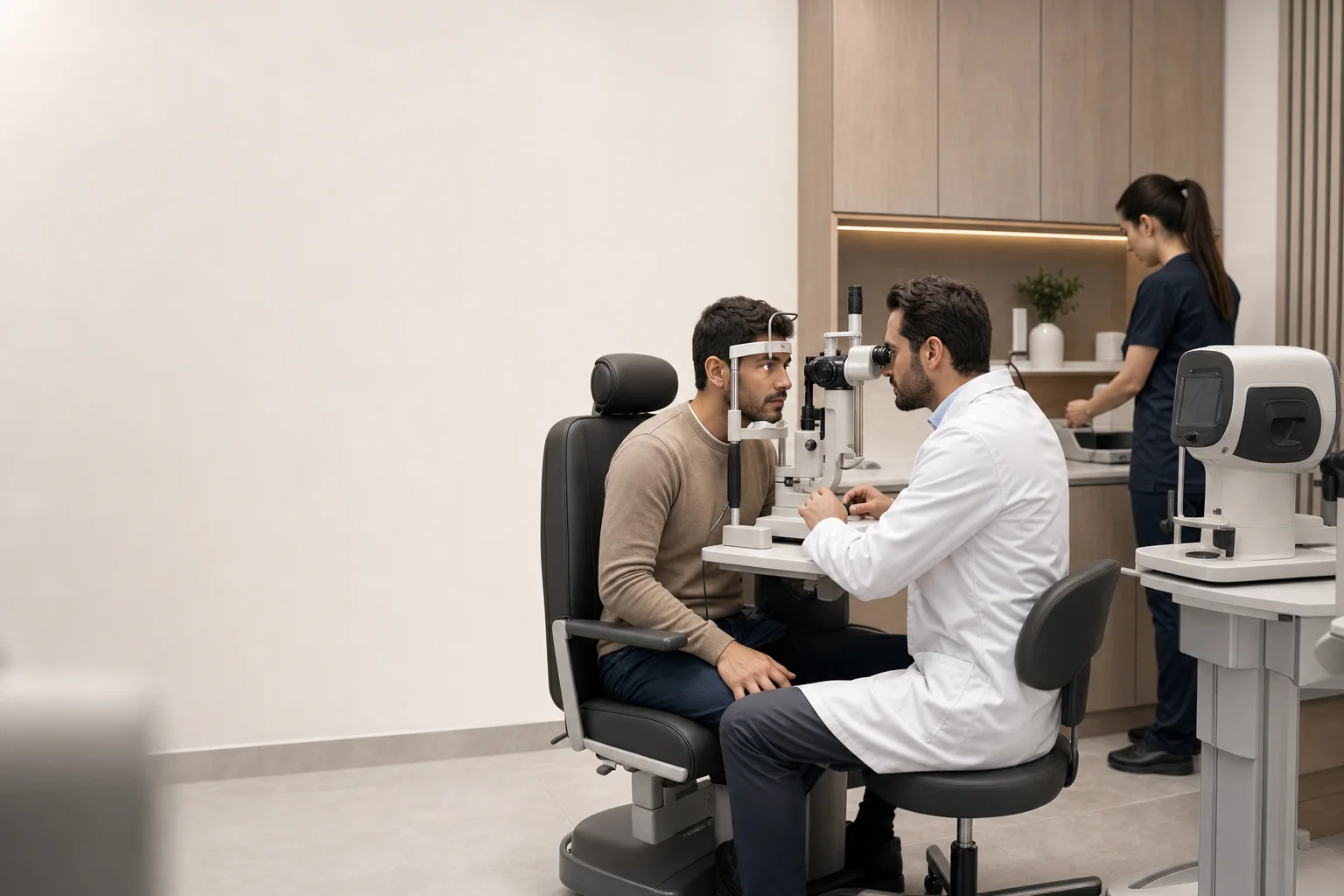
The ergonomics of an ophthalmic workstation are defined by interactions. The patient must be able to approach and sit without ambiguity. The practitioner must be able to maintain a coherent working posture and visual relationship with the patient. The assistant must be able to prepare, support and reset the workstation without cutting across the clinical sequence. This coordination is more meaningful than an approach based solely on the appearance of the furniture.
This approach connects the unit to the wider examination environment. When the workstation and chair are considered together, the team can assess patient access, practitioner position, instrument relationship, circulation and cleaning requirements as one installation rather than as separate purchasing decisions. The value comes from continuity between components and clinical use, not from adding isolated equipment without an overall plan.
Plan for every practitioner who will use the room
A single workstation may be used by several ophthalmologists, optometrists, assistants or visiting professionals. An installation that depends too heavily on one person’s habits can quickly lose efficiency. The stronger approach is to establish a legible routine: consistent accessory locations, clear circulation, accessible instruments and surfaces that can be maintained according to the practice’s hygiene procedures. Standardisation does not mean restricting clinical judgement; it reduces avoidable variation around it.
The ergonomic mechanism is alignment between the selected configuration and the user’s working pattern. When the workstation supports the practitioner’s preferred direction, lateral repositioning and unnecessary crossings can be better controlled. In practice, laterality should be reviewed with the clinicians and assistants who will use the room, before the layout and order are confirmed.
Why a dedicated unit is stronger than an improvised assembly
A collection of independent tables, stands and storage elements may appear adequate in a preliminary layout. It becomes more difficult to manage when instruments, chair position, accessories, cleaning routines and circulation must remain coherent over time. Each separate element brings its own footprint, access logic and maintenance requirements. The arrangement may function, but it demands more organisational discipline from the team and more frequent adjustment when the room is used by different practitioners.
A refraction unit provides a more deliberate architectural basis. The steel-and-wood construction, storage provisions where included, compatibility with the F.I.S.O. ophthalmic-chair range and availability of left-handed versions on most models all support the same objective: creating a workstation that can be repeated reliably from one consultation to the next. The unit becomes a platform for clinical organisation rather than a surface on which several devices simply happen to be placed.
The decision can then be made on the right basis. The unit is not expected to solve the organisation of the entire practice on its own. It is used as the platform around which instruments, gestures, responsibilities and patient movement are arranged. That connection between equipment and method is what creates a more fluid examination. The workstation stops being a simple location and becomes an instrument of clinical continuity.
A professional equipment decision should be prepared on site
Before finalising the order, ASEM advises a technical review centred on actual use: a measured room plan, doors and circulation zones, practitioner and assistant positions, the instruments genuinely required, trial-lens storage, management of the ophthalmoscope and skiascope, working direction, chair selection and cleaning workflow. This preparation improves configuration accuracy and reduces the risk of corrections after installation.
F.I.S.O.’s official download area also provides user manuals, brochures, catalogues and certificates for its products. These documents can support the technical and documentary review of the project, alongside a concrete assessment of the room, the clinical workflow and the configuration to be supplied.
Share this article
Professional FAQ
Why bring two instruments together in one refraction unit?
A two-instrument unit can organise successive examination steps around one patient-practitioner area. The value is not simply the number of instruments accommodated, but the reduction of unnecessary movements, interruptions and peripheral handling during the clinical sequence.
What is verified about the Easyvisus MS33 — 2 instruments?
The Easyvisus MS33 — 2 instruments is listed by F.I.S.O. as a two-instrument refraction-unit configuration. F.I.S.O.’s range also includes units for three instruments. The available verified information does not establish specific MS33 table mechanisms, control interfaces, dimensions, accessories or a particular chair model.
What should be assessed before installing a two-instrument workstation?
Review the room plan, patient route, practitioner and assistant positions, instrument access, accessory storage, power access, cleaning requirements, laterality and compatibility with the selected ophthalmic chair. Most F.I.S.O. refraction-unit models are also available in a left-handed version, which should be considered before installation.
Are F.I.S.O. refraction units suitable for a durable clinical organisation?
F.I.S.O. states that its refraction units are made entirely of steel and wood and associates this construction with stability, sturdiness and reliability. The final decision should still reflect the intended workload, room environment, selected configuration and local installation requirements.
Sources and references
Official catalogue
-
FISSO medical product downloads
F.I.S.O. · fisso.com
Accessed 2026-10-14 -
F.I.S.O. refraction units
F.I.S.O. · www.fiso.info
Accessed 2026-10-21
Events related to this topic

Vision to Venture Weekend 1
Budapest, HungaryEuropean Society of Cataract and Refractive Surgeons
A professional ophthalmology event organised by European Society of Cataract and Refractive Surgeons. Plea...
31st ESCRS Winter Meeting
Le Caire, EgyptEuropean Society of Cataract and Refractive Surgeons
A professional ophthalmology event organised by European Society of Cataract and Refractive Surgeons. Plea...
ASCRS Annual Meeting 2027
San Diego, United StatesAmerican Society of Cataract and Refractive Surgery
A professional ophthalmology event organised by American Society of Cataract and Refractive Surgery. Pleas...