What Equipment Supports a Combined Cataract–Retina Practice?
For cataract surgery, vitrectomy and combined procedures, a phaco-vitrectomy platform should be assessed through fluidics, illumination, auxiliary functions, ergonomics, consumables and operational continuity.
In this article
- 1. Start with the real case mix, not the catalogue
- 2. Fluidics must follow changes in operative phase
- 3. In phacoemulsification, connect ultrasound delivery with material control
- 4. In retinal surgery, illumination and auxiliary functions are decisive
- 5. The console should serve the gesture, not add complexity
- 6. Consumables and support determine service continuity
- 7. Turn technical assessment into an installation decision
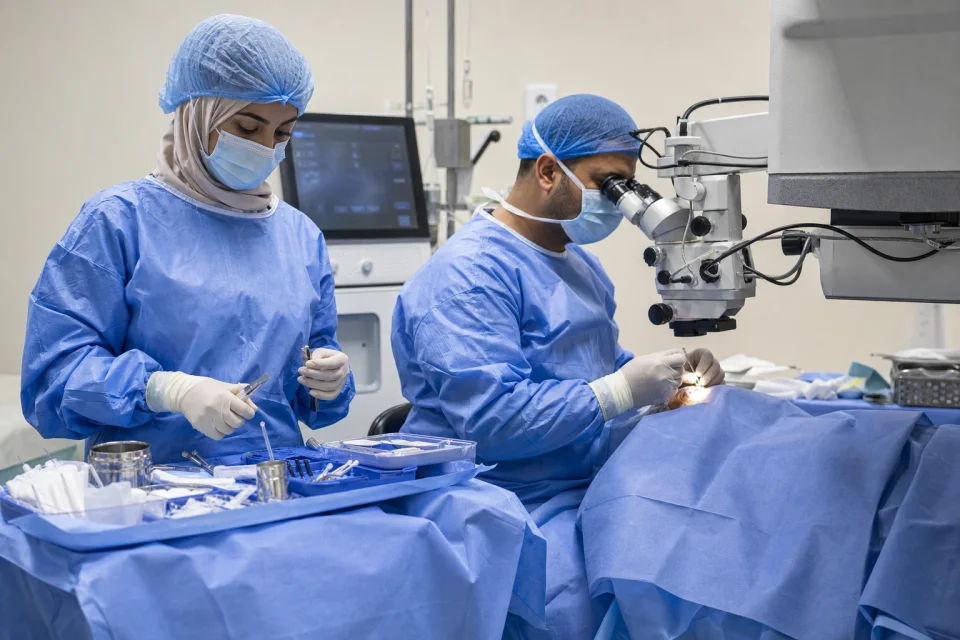
The first criterion is therefore not the longest feature list. It is whether the equipment remains understandable and controllable when the operating schedule alternates between phacoemulsification, vitrectomy and combined surgery. Cataract-surgery quality must be considered across the preoperative, intraoperative and postoperative phases; the operating-room platform sits within that same care pathway, alongside protocols, training and the wider organisation of the surgical service.
1. Start with the real case mix, not the catalogue
A clinic treating both cataract and retinal disease should first map its actual operative scenarios: conventional anterior-segment surgery, cases requiring a posterior approach, vitrectomy, fluid–air exchange, silicone-oil management and combined procedures. This map separates genuinely structuring functions from options that are rarely used. It also anticipates instrument circulation, kit preparation, staff training and the way the platform will be deployed across the operating list.
2. Fluidics must follow changes in operative phase
In mixed practice, fluidics is the centre of the technical assessment. The requirements of phacoemulsification and vitrectomy cannot be reduced to one fixed relationship between flow, vacuum, aspiration and pressure. The surgeon needs to adapt the system’s dynamic response to the operative phase, tissue behaviour and instrument in use. This is where the R-Evolution CR enters the discussion naturally: BVI Medical presents it as a phaco-vitrectomy system for cataract, vitreoretinal and combined procedures, with a fluidic architecture designed to offer multiple control options.
The mechanism matters. A peristaltic pump creates aspiration through controlled displacement of fluid, whereas a Venturi pump is based on vacuum generation. Choosing between these principles is more than an additional console setting: it allows the fluidic response to be matched to the gesture, sequence and level of control required. In practical terms, the team is not forced to conduct every phase through one aspiration model.
Dynamic intraocular pressure compensation completes this architecture. By supporting fluidic stability through the different phases of anterior- and posterior-segment surgery, it connects console parameters with the intraocular environment. For a combined service, this is a central consideration: fluidics should not be viewed as a series of disconnected settings, but as a system that remains coherent as the procedure progresses.
3. In phacoemulsification, connect ultrasound delivery with material control
Assessing a phaco-vitrectomy platform should not stop at confirming that a phaco module is present. The evaluation should examine how ultrasound delivery, aspiration and console settings work together in lens-material management. A convincing architecture is one that gives the surgeon an intelligible response as lens resistance changes.
The technology chain is clear: the protocols modulate energy delivery, while adaptive management seeks to maintain a consistent tip response as lens resistance changes. The practical interest for the surgeon is a more predictable phacoemulsification environment during transitions, without separating ultrasound control from the fluidic strategy. The platform’s value lies in the interaction between energy, aspiration and programming, rather than in any single mode considered in isolation.
4. In retinal surgery, illumination and auxiliary functions are decisive
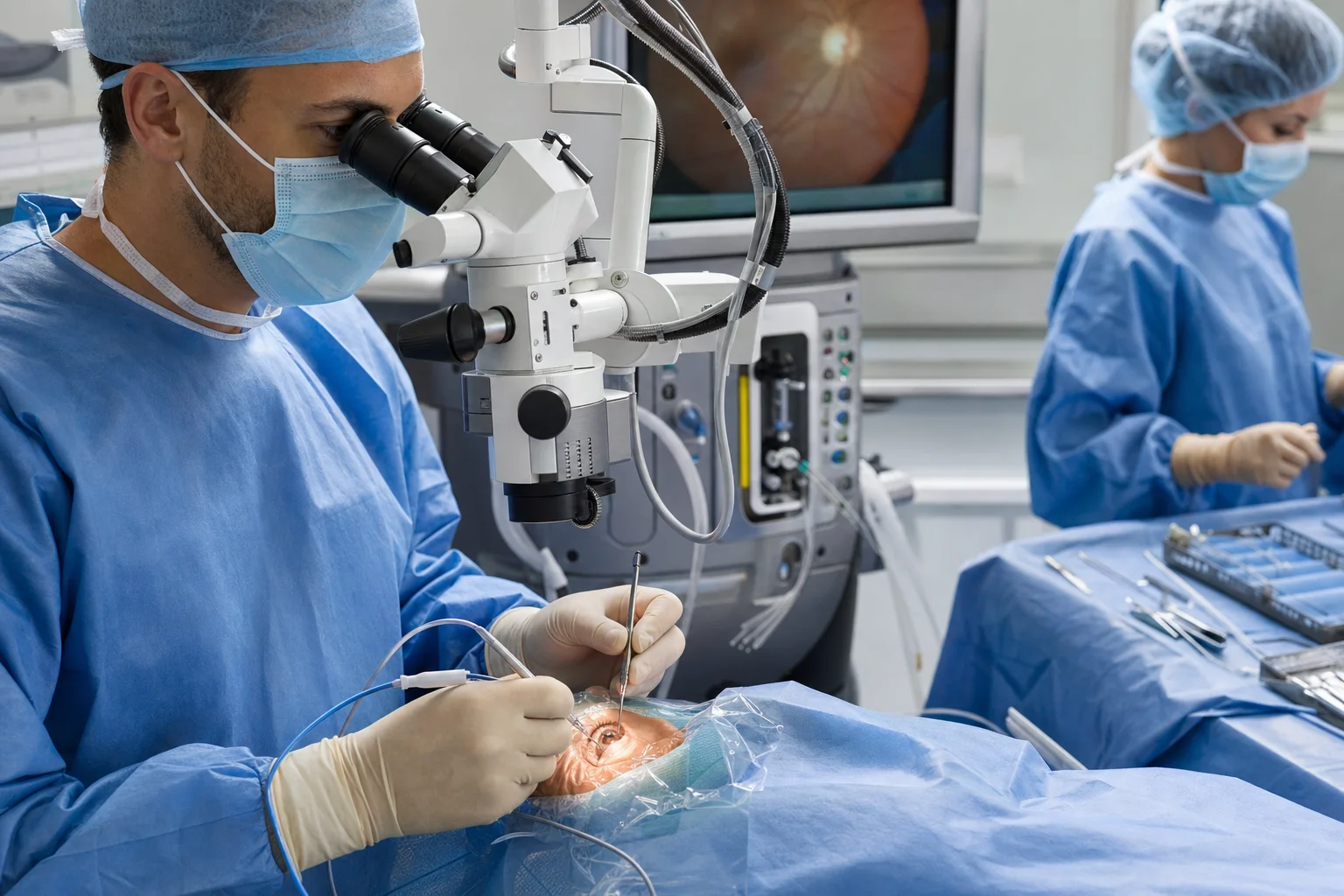
Posterior-segment surgery imposes a different requirement: the equipment must provide illumination suited to the operative field and incorporate functions that prevent the procedure from being fragmented across several systems. Illumination is not a peripheral accessory. It affects field interpretation, precision of manoeuvres and workflow continuity when the intervention becomes vitreoretinal.
Three independent outputs make it possible to keep several illumination pathways available and adapt them during the intervention. Selectable colour filters add a further means of tailoring visualisation. Combined with a wide-angle probe, this creates a technically coherent set for procedures in which panoramic viewing and field legibility must remain available without reorganising the entire console.
These functions have a direct organisational consequence. When they are integrated into one platform, the team limits changes in system architecture during surgery and works through a more continuous control logic. The benefit is not simply a smaller equipment footprint. It is the reduction of workflow interruptions, more standardised preparation and a configuration that is easier for both the surgeon and scrub team to understand.
5. The console should serve the gesture, not add complexity
A comprehensive platform can lose much of its value if its interface slows action or its controls are difficult to access. In a combined practice, ergonomics should be assessed in context: selecting a protocol, changing phase, calling an auxiliary function, controlling aspiration and using the pedal. The team must be able to understand the system’s logic and reproduce it in internal protocols.
The pedal is the operational extension of the console. A wireless design may help clear space around the operating position and simplify installation, while an interface designed for immediate interaction brings settings closer to the operative decision. The practical benefit will depend on the final configuration and team familiarity, so it should be verified in a technical demonstration attended by surgeons and operating-room staff.
6. Consumables and support determine service continuity
Platform selection does not end with the console. A mixed service requires consistency between probes, trocars, injection and removal kits, single-use instruments and preparation protocols. The management team should also address maintenance, initial training, availability of parts or consumables and the technical-assistance pathway. A premium solution is one that remains workable over time, with clear organisation around the equipment.
This ecosystem dimension belongs in the specification from the outset. The operating room needs to know whether available configurations match the procedures actually performed and whether required references can be planned with the expected regularity. ASEM therefore approaches the platform, accessories, kits, training pathway and local support as one technical discussion rather than separate issues addressed only after installation.
This combination is particularly relevant when the operating room must move from an anterior-surgery logic to a posterior-surgery logic without changing its underlying control philosophy. Pars plana phacoemulsification, wide-angle illumination and vitreoretinal auxiliary functions reinforce that procedural scope. ASEM considers the R-Evolution CR a priority platform to evaluate for a combined activity, provided that the exact configuration, accessories, consumables and availability in Algeria are confirmed with the local distributor or BVI Medical.
7. Turn technical assessment into an installation decision
What to document during the demonstration
- Run a cataract scenario, a vitreoretinal scenario and a combined procedure.
- Select the pump and move between flow-based and vacuum-based aspiration.
- Review the dynamic intraocular pressure compensation response through the different phases.
- Use the ultrasound protocols and examine the logic of Minimal Stress.
- Select LED outputs and colour filters, then assess the wide-angle illumination probe.
- Activate fluid–air exchange, silicone-oil injection and oil-removal functions.
- Assess the interface, pedal and controls from the actual operating position.
- Match planned procedures with kits, accessories, training requirements and technical support.
The issue extends beyond acquiring equipment. A phaco-vitrectomy platform influences procedure standardisation, team preparation and the operating room’s ability to maintain a consistent quality of care. The World Health Organization notes that timely access to quality eye care can mitigate many consequences of vision impairment and identifies cataract surgery among the most cost-effective health-care interventions. For an ophthalmic facility, technology should therefore be selected as one component of a care pathway, with the same level of attention given to configuration, training and follow-up.
Share this article
Professional FAQ
What are the priority criteria for a phaco-vitrectomy platform?
Priority criteria include coherent fluidics, available aspiration modes, intraocular pressure management, posterior-segment illumination, exchange and injection functions, ergonomics, consumable organisation, training and technical support.
Is the R-Evolution CR intended for combined procedures?
BVI Medical presents the R-Evolution CR as a phaco-vitrectomy system for cataract, vitreoretinal and combined procedures. The selected configuration must then be confirmed locally with the distributor regarding accessories, consumables and availability.
Why compare a peristaltic pump with a Venturi pump?
The two principles do not provide exactly the same approach to aspiration control. Selecting the pump allows the fluidic strategy to be adapted to the operative phase and surgeon preference rather than imposing one aspiration architecture throughout the procedure.
Sources and references
Official product
-
R-Evolution CR
BVI Medical · R-Evolution CR · www.bvimedical.com
Accessed 2026-08-12
Institutional Source
-
Blindness and vision impairment
BVI Medical · R-Evolution CR · www.who.int
Accessed 2026-08-09 -
Summary of recommendations for quality of care in cataract surgery management
BVI Medical · R-Evolution CR · www.who.int
Accessed 2026-08-09
Official catalogue
-
BVI Medical product catalogues
BVI Medical · www.bvimedical.com
Accessed 2026-08-12 -
BVI ophthalmic consumables
BVI Medical · www.bvimedical.com
Accessed 2026-08-12
Events related to this topic

Euretina Innovation Spotlight (EIS)
Vienne, AustriaEURETINA
A professional ophthalmology event organised by EURETINA. Please consult the official source for the lates...
26th Euretina Congress
Vienne, AustriaEURETINA
A professional ophthalmology event organised by EURETINA. Please consult the official source for the lates...
Vision to Venture Weekend 1
Budapest, HungaryEuropean Society of Cataract and Refractive Surgeons
A professional ophthalmology event organised by European Society of Cataract and Refractive Surgeons. Plea...