
Octopus 900
Static perimetry; other capabilities depend on the configuration.
Static test patterns for central and peripheral fields.
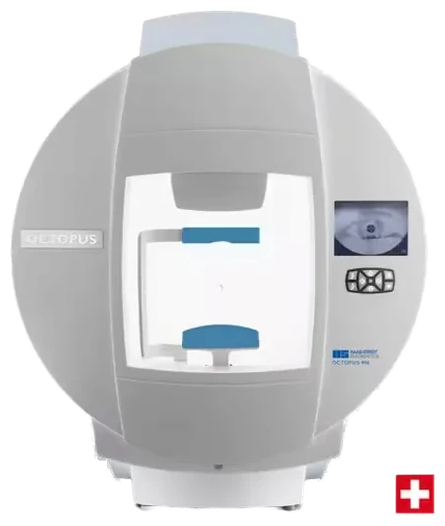
Key advantages
The documented strengths of Octopus 900, at a glance.
Full-field static perimetry
Static test patterns for central and peripheral fields.
Kinetic field examination
Kinetic testing depending on the version and licence.
Option depends on version
Global progression analysis
Global progression analysis of serial visual fields.
Assess the full visual field
Documented programmes cover central and peripheral examinations in one system.
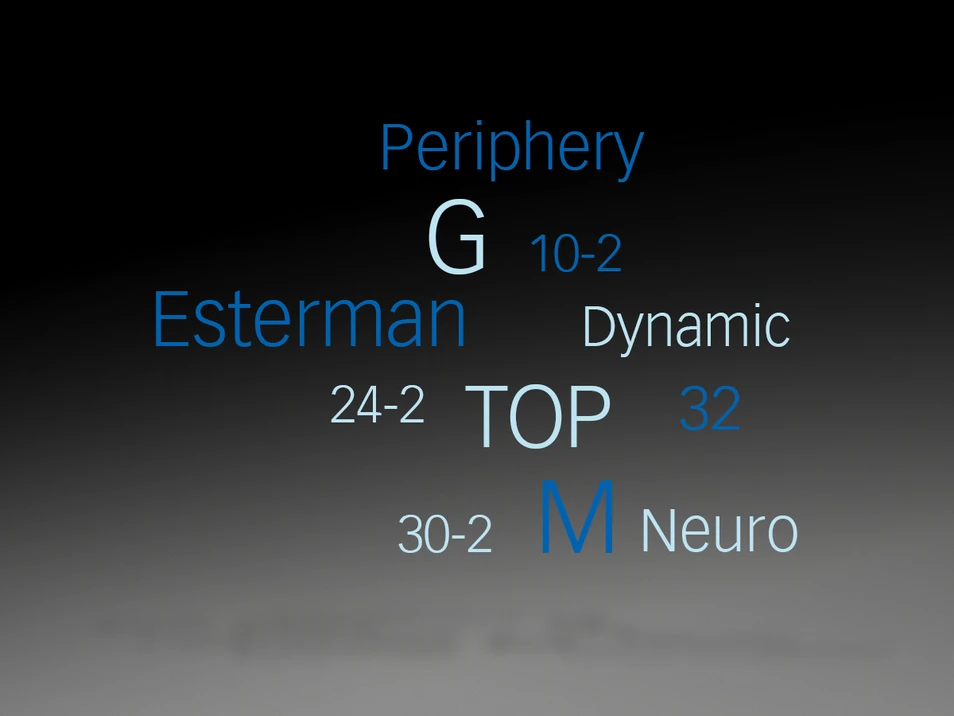
Manufacturer illustration: the configuration shown may differ from the delivered configuration.
Standardise analysis
EyeSuite groups indices and representations used in the perimetry workflow.
Track progression
Progression views support comparison of functional examinations over time.
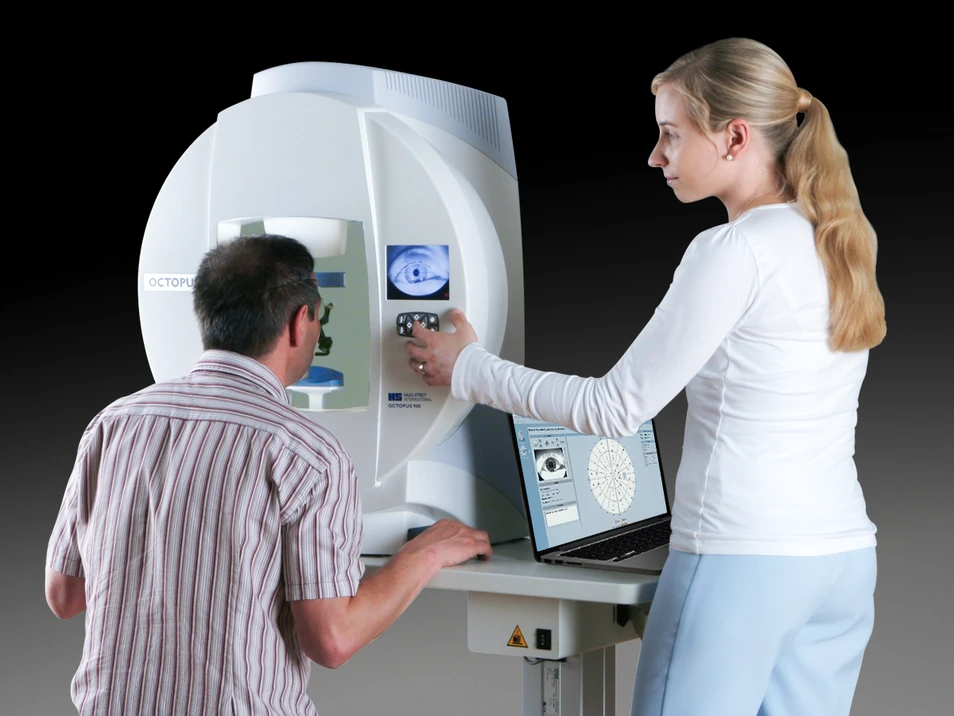
Manufacturer illustration: the configuration shown may differ from the delivered configuration.
Capabilities in practice
A closer look at the functions and technology of Octopus 900.
Examining central and peripheral visual fields
Peripheral field: 180° Bowl radius: 30 cm Goldmann stimulus sizes: I / II / III / IV / V Dynamic range: 47 dB The stimulus is projected within a bowl. Documented patterns include central 24-2 and 10-2 tests, G and M programmes and peripheral examination. The professional selects the programme for the clinical question; a test’s presence does not imply automatic diagnosis or a legal determination of driving fitness.
View sourceMethods and strategies: checking Basic or Pro
Standard white-on-white perimetry is documented for Basic and Pro. The table distinguishes optional Basic packages for TOP, Goldmann kinetic testing, blue/yellow and certain specialised examinations. Indicative strategy times are TOP 2–4 minutes, Dynamic 6–8 minutes and Normal 10–12 minutes; they do not guarantee an individual examination duration. Kinetic testing and actually enabled options must be identified in the quotation.
View source
Manufacturer illustration: the configuration shown may differ from the delivered configuration.
From centre to periphery
The Goldmann bowl supports central and peripheral examinations. The brochure describes a full 180° field and programmes including G, M and binocular Esterman.
View sourcePlot kinetic isopters
Goldmann kinetic perimetry supports vectors, isopters and examination templates. Availability depends on the installed version and options.
Optional on Basic; standard on Pro in the current manufacturer table.
View sourceDesigned for a smoother workflow
Fixation control and reviewing results
The series documents Blink Control, Pupil Position Control and automated eye tracking (AET). EyeSuite brings together global analysis and progression views; Cluster/Polar Trend analysis depends on configuration packages. Fixation monitoring and indices support professional interpretation without replacing assessment of each examination’s reliability.
Network and patient-record integration
Ethernet connectivity and EyeSuite organise examinations and viewing stations. The brochure lists imports from older Octopus instruments and compatible HFA data. DICOM is marked optional; EMR interfaces, versions and transfers must be verified in the actual installation. Universal connection to every patient-record system is not promised.
Guide test execution
Guided examination, multilingual patient instructions and fixation monitoring structure the test. Stimuli missed during blinking can be presented again.
Compare fields over time
EyeSuite brings fields, global analysis and trend views together. Octopus or HFA-style presentations support the practice’s review preferences.
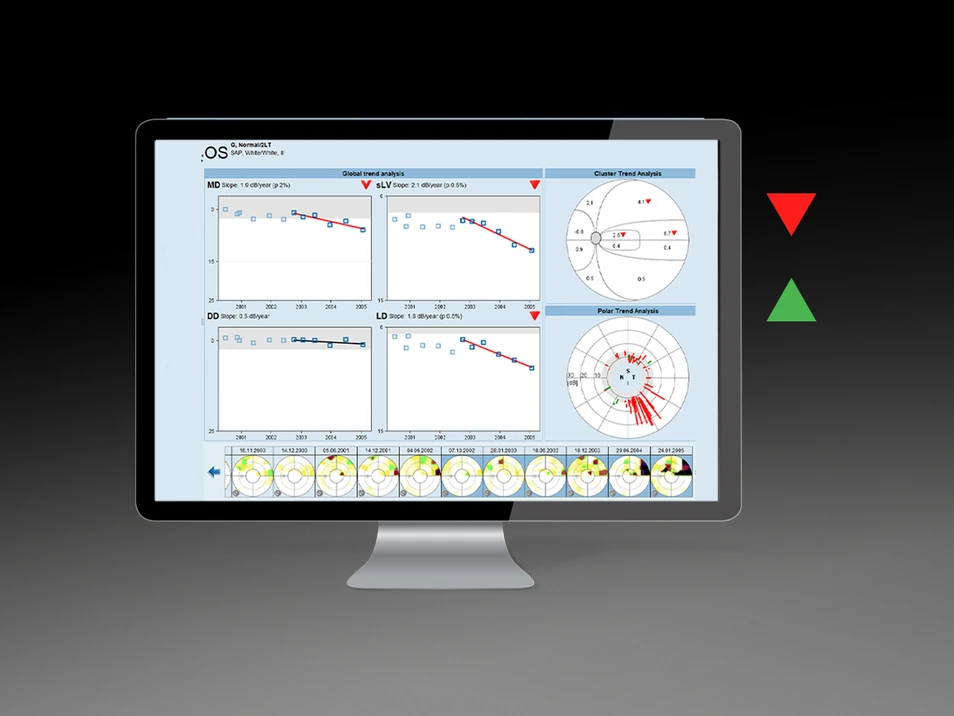
Manufacturer illustration: the configuration shown may differ from the delivered configuration.
Designed for daily practice
Explore the documented features and practical configuration of Octopus 900.
Monitor the trial correction
The documented configuration includes a motorised trial-lens holder and distance monitoring. Pupil and fixation controls support positioning.
Manufacturer illustration: the configuration shown may differ from the delivered configuration.
Installation and configuration
Width: 648 mm Depth: 519 mm Height: 796 mm Weight: 25 kg Frequency: 50/60 Hz The instructions specify two power-supply ranges: 100–120 V AC or 220–240 V AC. Stated consumption is 145 / 165 VA according to configuration. Installation, support, licences and network equipment must be confirmed with ASEM. The 40 kg shipping weight including packaging is not the device weight and is not used as a net value.
Define the Basic or Pro scope
SWAP, Flicker, red stimuli, kinetic testing and TOP are not universally included. The quotation must specify version, tests, analysis and interfaces.
Technical information
Technical specifications & documentation
Product information, specifications and available documentation in one place.
Product specifications overview
Key documented information for this exact model.
- Brand
- Haag-Streit
- Model
- Octopus 900
- Technology
- Perimeter
- Clinical use
- Diagnostics and biometry
Technical specifications
- Stimulus sizes
- Goldmann I · Goldmann II · Goldmann III · Goldmann IV · Goldmann V
- Maximum stimulus intensity
- 10000 asb
- Software
- EyeSuite
- Weight
- 12.7 kg
Downloads & resources
Available product sheets and public manufacturer resources.
Sources and documentation
- https://haag-streit.com/en/products/categories/specialty-diagnostics/perimetry/octopus-900Verified on 2026-10-05
- https://haag-streit.com/en/products/categories/specialty-diagnostics/perimetry/octopus-900Verified on 2026-10-06
- https://haag-streit.com/2%20Products/Speciality%20diagnostics/Perimetry/Octopus%20900/Brochures/English/HS_Oktopus_900_br_7220444_english.pdfVerified on 2026-10-06
- https://haag-streit.com/2%20Products/Speciality%20diagnostics/Perimetry/Octopus%20900/Instructions%20for%20use/English/1500_7220343_04121_IFU_OCTOPUS_900_01_en_web.pdfVerified on 2026-10-06
- https://haag-streit.com/en/products/categories/specialty-diagnostics/perimetry/octopus-900Verified on 2026-10-17
- https://haag-streit.com/en/products/categories/specialty-diagnostics/perimetry/octopus-900Verified on 2026-08-30
- https://haag-streit.com/2%20Products/Speciality%20diagnostics/Perimetry/Octopus%20900/Brochures/English/HS_Oktopus_900_br_7220444_english.pdfVerified on 2026-10-18
- https://haag-streit.com/2%20Products/Speciality%20diagnostics/Perimetry/Octopus%20900/Brochures/English/HS_Oktopus_900_br_7220444_english.pdfVerified on 2026-10-18
- https://haag-streit.com/2%20Products/Speciality%20diagnostics/Perimetry/Octopus%20900/Brochures/English/HS_Oktopus_900_br_7220444_english.pdfVerified on 2026-10-18
- https://haag-streit.com/2%20Products/Speciality%20diagnostics/Perimetry/Octopus%20900/Brochures/English/HS_Oktopus_900_br_7220444_english.pdfVerified on 2026-10-18
- https://haag-streit.com/en/products/categories/specialty-diagnostics/perimetry/octopus-900Verified on 2026-10-18
- https://haag-streit.com/en/products/categories/specialty-diagnostics/perimetry/octopus-900Verified on 2026-10-18
- https://haag-streit.com/en/products/categories/specialty-diagnostics/perimetry/octopus-900Verified on 2026-10-18
- https://haag-streit.com/en/products/categories/specialty-diagnostics/perimetry/octopus-900Verified on 2026-10-18
- https://haag-streit.com/en/products/categories/specialty-diagnostics/perimetry/octopus-900Verified on 2026-10-18
Frequently asked questions
Your questions about Octopus 900
Clear answers based on the available product information.

What is the documented Stimulus sizes of Octopus 900?
Goldmann I · Goldmann II · Goldmann III · Goldmann IV · Goldmann V
View sourceWhat is the documented Maximum stimulus intensity of Octopus 900?
10000 asb
View sourceWhere can I find the documentation for Octopus 900?
Manufacturer documentation (PDF) — https://asem-medical.com/storage/catalogue-enrichment/haag-streit-remaining-20261006/octopus900-original.pdf Manufacturer documentation (PDF) — https://asem-medical.com/storage/catalogue-enrichment/haag-streit-remaining-20261006/octopus900-ifu-original.pdf
View sourceIs Goldmann kinetic perimetry always included?
No. The current table distinguishes a Basic option from a Pro standard feature.
View sourceCan results use an HFA-style presentation?
Yes. EyeSuite offers Octopus and HFA-style views for the documented fields and reports.
View sourceIs a binocular Esterman test documented?
Yes. It is among the listed programmes for binocular-field assessment.
View sourceASEM support
More than a device, a long-term partnership
Discuss your project with ASEM: equipment selection, installation, training and technical support.
Installation
Discuss the installation requirements and configuration with our technical team.
Learn more

After-sales service
Contact ASEM for technical assistance and the support appropriate to your equipment.
Learn more

Related products
Explore equipment with related technologies and clinical uses.
Clinical applications
Explore the ASEM clinical catalogue
Browse related areas of the ASEM catalogue. These links do not extend the indications of this device.
Explore all products