Choosing a Compact Ophthalmic Unit for a Satellite Practice
A satellite practice needs more than a small footprint. The right refraction unit must protect clinical workflow, patient access, practitioner ergonomics and future flexibility without pretending to replace a complete ophthalmic platform.
In questo articolo
- Start with the clinical flow, not the catalogue
- One instrument or several: a clinical and spatial decision
- Easyvisus Two: an early reference for the project discussion
- Ergonomics is the real value of a compact unit
- Stability and materials matter in a small room
- Storage protects the clinical sequence
- The chair and unit must be designed as one system
- Compact does not mean clinically incomplete
- Design for realistic evolution
- ASEM’s recommendation for a satellite practice
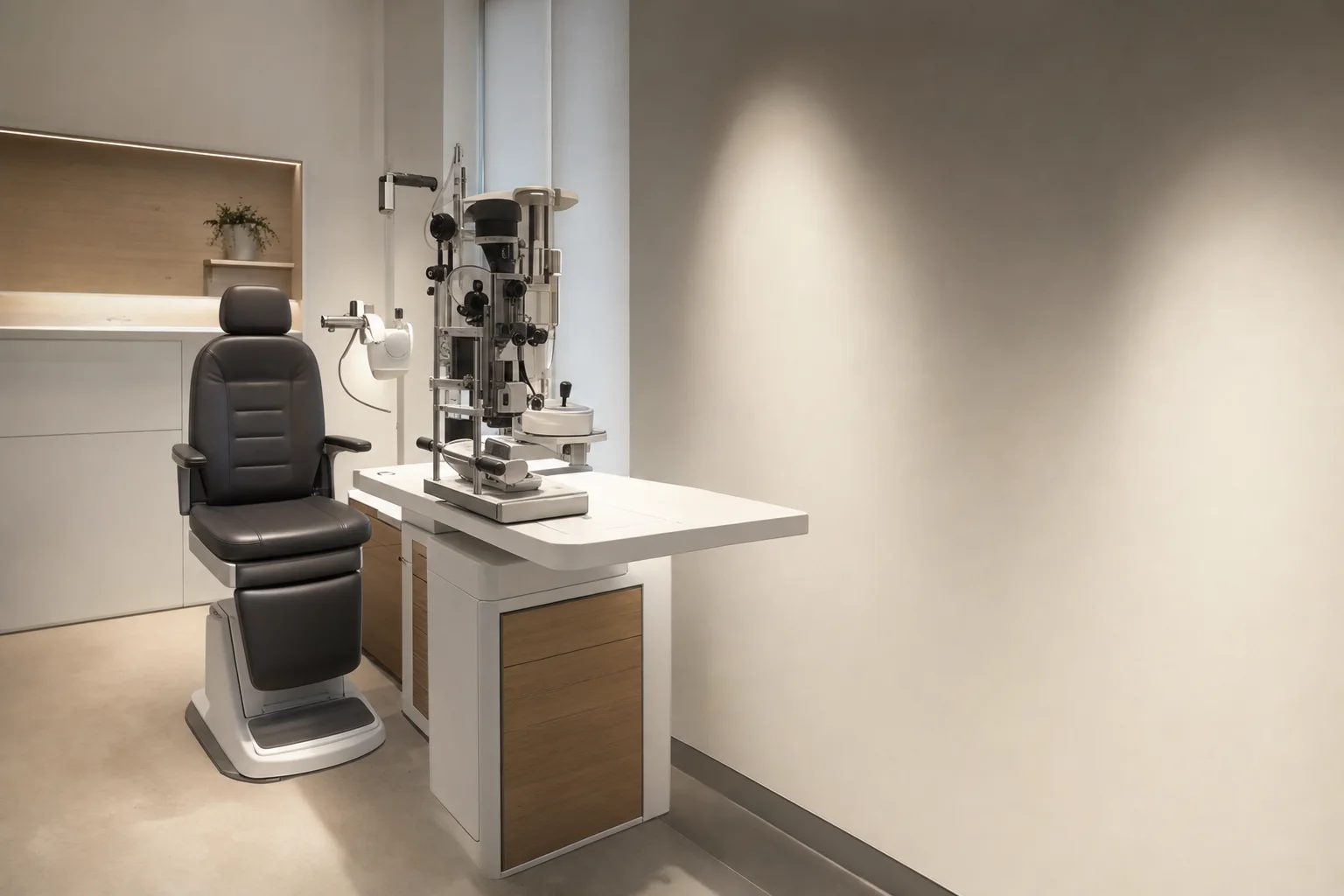
In a satellite practice, every square metre should support an identifiable clinical action. An oversized unit can restrict movement around the chair, complicate patient installation and turn refraction into a sequence of workarounds. Conversely, an under-equipped station can force the practitioner to leave the patient, move between surfaces or keep essential accessories too far from the examination position. The correct objective is therefore not simply the smallest possible unit. It is the most compact arrangement that remains compatible with the quality and rhythm of examination required.
Start with the clinical flow, not the catalogue
The first question is what the room is actually expected to do. A satellite practice may handle follow-up consultations, structured refraction, screening, preoperative orientation or several of these activities in combination. Those scenarios do not necessarily require the same instrumental density. The unit should therefore be sized from the real patient pathway: entry, seating, examination, instrument changes, discussion with the patient or accompanying person, and exit.
One instrument or several: a clinical and spatial decision
A one-instrument concept follows a clear logic: reduce the footprint, preserve straightforward patient access and avoid overbuilding a secondary room. Yet room width alone cannot validate the choice. The team must consider the instrument actually intended for the room, how it is accessed, where the practitioner sits or stands, how refraction accessories are handled and how much clear space is required around the chair.
The official F.I.S.O. refraction-unit page consulted for this project lists Easyvisus models for two or three instruments, including RM64 COMPACT 2 Instruments and RM64 COMPACT 3 Instruments. This is an important distinction: compact does not necessarily mean single-instrument. It may refer to a rationalised architecture that accommodates several functions within a controlled footprint. If the project genuinely requires a one-instrument workstation, the exact reference and configuration must be confirmed in advance rather than inferred from the product family name.
Easyvisus Two: an early reference for the project discussion
This is a stronger technical approach than presenting generic compactness as a complete solution. It separates the documented manufacturer range from the configuration ultimately delivered. For an ophthalmologist, the relevant question is not only whether the unit can physically enter the room. It is whether the workstation remains functional when the patient, practitioner, chair, instruments and accessories occupy the room simultaneously.
Ergonomics is the real value of a compact unit
A refraction unit is a repetitive workstation. Its value is therefore not measured solely by how many devices it can accommodate, but by the quality of the transitions between examination stages. Ergonomics begins with patient installation and continues through the relationship between chair, tabletop, accessories, practitioner visual field and available lateral movement.
The mechanism is straightforward. When useful functions are grouped and accessible, the practitioner makes fewer unnecessary movements, rotations and interruptions. The technical interest is twofold: posture can remain more consistent, and clinical attention can stay focused on the patient. The practical consequence is a more controlled consultation, particularly valuable when the room cannot accommodate multiple storage zones or auxiliary work surfaces.
F.I.S.O. presents its refraction units as solutions intended to support complete and functional work while limiting fatigue. That positioning is consistent with the demands of a satellite practice. A compact unit should reduce dispersion of the clinical gesture, not merely reduce the amount of floor space occupied.
Stability and materials matter in a small room
In a restricted space, technical furniture is used close to both patient and practitioner. Contact with the workstation, repositioning and changes of examination sequence make stability especially important. A structure that moves, flexes or feels poorly integrated can disturb access, comfort and the perceived quality of the consultation environment.
The value chain is direct: steel and wood provide the documented construction basis; stability supports the integrity and reliability of the workstation in daily use; the practical result is a more coherent environment for practitioner and patient. In a satellite room, this helps avoid compensating for limited space with improvised peripheral furniture or disconnected storage solutions.
Storage protects the clinical sequence
Storage should be designed around the accessories that are genuinely used, not around a theoretical inventory. An accessory left on a circulation surface soon becomes an obstruction. One stored too far away creates a movement. One permanently exposed may make the workstation less legible and more difficult to keep orderly.
This principle is particularly relevant in a secondary room. Foldaway storage can free the working surface when an accessory is not in use while keeping it near the examination position. The technical interest is not the drawer in isolation, but its relationship with the overall workstation: fewer loose objects, a clearer reading of the room and a faster transition to the next step. The final storage package remains a configuration point to validate.
The chair and unit must be designed as one system
A compact unit should never be selected independently of the ophthalmic chair. Height, patient access, practitioner position and lateral clearance form one operational system. A small workstation paired with an unsuitable chair can cancel the spatial benefit that motivated the project in the first place.
Compact does not mean clinically incomplete
The purpose of a compact unit is to organise a defined examination function, not to imitate a full ophthalmic platform. Diagnostic imaging, treatment devices and other clinical systems must be assessed separately. The workstation should therefore be judged against the activities assigned to the satellite room: what must happen there every day, what can remain at the main site, and what needs to be available immediately during refraction?
This distinction prevents two common errors. The first is overinvestment: filling a small room with equipment that does not support its actual clinical role. The second is under-specification: choosing a minimal arrangement that forces the practitioner to leave the patient or rely on improvised surfaces. The correct solution sits between these extremes and is defined by workflow rather than by the number of items installed.
Design for realistic evolution
Evolution does not mean purchasing the densest configuration immediately. It means avoiding an architecture that rules out every future adaptation. The room may later be used by another examiner, assigned a different clinical role, or expected to support an additional instrument or accessory. That possibility should be considered without sacrificing the clarity of the current workflow.
F.I.S.O. presents several refraction-unit architectures with attention to functionality, comfort, stability and design. This range supports a configurable approach to the satellite workstation, but it does not replace technical confirmation of the selected reference and options. ASEM recommends a two-stage decision: define the immediate clinical requirement, then verify that the chosen installation leaves a realistic margin for future change.
What to validate before ordering
- The actual room dimensions and clearances around the chair.
- The instrument or instruments intended for the room, without extrapolating from the family name alone.
- The direction of use and whether a left-handed version is appropriate.
- The location of trial lenses, ophthalmoscope, skiascope and other frequently used accessories.
- Compatibility between the unit, chair and the patient’s entry and exit path.
- The desired future adaptations and their effect on circulation.
- The precise commercial configuration and accessories available for the selected reference.
- Which features are included, optional or subject to separate confirmation in the final technical quotation.
ASEM’s recommendation for a satellite practice
The objective is not to present a compact unit as a complete ophthalmic platform. It is to create a coherent workstation with clear circulation, controlled ergonomics and a realistic margin for adaptation. In that context, the Easyvisus Two should be evaluated as a project solution rather than as a piece of furniture placed in whatever corner remains available.
For pricing, F.I.S.O.’s official downloads page states that customers should contact the responsible Sales Manager. ASEM can support that exchange by structuring the information that makes a quotation technically useful: room plan, clinical activity, intended instruments, laterality preference, storage requirements and desired evolution.
Condividi questo articolo
Domande frequenti dei professionisti
Can a compact unit replace a complete ophthalmic platform?
No. A compact unit organizes an examination and refraction workstation. It does not automatically replace diagnostic, imaging or treatment equipment, which must be assessed separately according to the practice’s clinical activity.
Is the number of instruments the main selection criterion?
It is important, but not sufficient. Instrument access must be assessed together with patient positioning, practitioner posture, accessory storage, circulation, chair compatibility and the possibility of future changes.
What is documented about the Easyvisus configurations?
The official F.I.S.O. page lists Easyvisus models for two and three instruments, including RM64 COMPACT 2 Instruments and RM64 COMPACT 3 Instruments. The exact architecture, accessories and delivered configuration for the selected Easyvisus Two must be confirmed with ASEM and the responsible F.I.S.O. sales contact.
Can a F.I.S.O. unit be configured for a left-handed practitioner?
F.I.S.O. states that most refraction-unit models are also available in a left-handed version. This possibility must be confirmed for the exact reference and configuration selected.
How can a project price be obtained?
F.I.S.O.’s official downloads page states that prices should be requested from the responsible Sales Manager. ASEM can structure the technical discussion around the room plan, clinical workflow, instruments and desired configuration.
Fonti e riferimenti
Catalogo ufficiale
-
FISSO medical product downloads
F.I.S.O. · fisso.com
Consultato il 2026-10-14 -
F.I.S.O. refraction units
F.I.S.O. · www.fiso.info
Consultato il 2026-11-04
Eventi correlati a questo argomento

31st ESCRS Winter Meeting
Il Cairo, EgittoEuropean Society of Cataract and Refractive Surgeons
Un evento professionale di oftalmologia organizzato da European Society of Cataract and Refractive Surgeon...
Riunione annuale ASCRS 2027
San Diego, Stati UnitiAmerican Society of Cataract and Refractive Surgery
Un evento professionale di oftalmologia organizzato da American Society of Cataract and Refractive Surgery...
39th APACRS Annual Meeting
Bali, IndonesiaAsia-Pacific Association of Cataract & Refractive Surgeons
Un appuntamento professionale di oftalmologia organizzato da Asia-Pacific Association of Cataract & Refrac...