
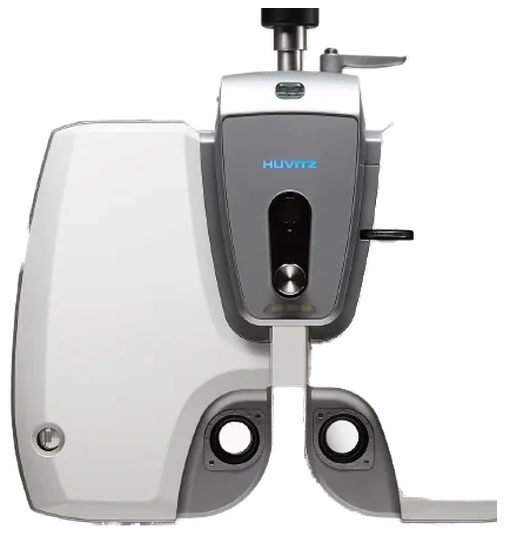
HDR-7100P
Refractor for distance and near subjective examination.
A dual cross cylinder that is 30% faster allows quick, precise astigmatism testing and cylinder axis assessment. Presbyopia and myopia examinations can be performed at the centre of the HDR-7100P window.

Key advantages
The documented strengths of HDR-7100P, at a glance.
Subjective refraction
Sphere from −29 to +26.75 D for visual examination.
Near vision
Working distance adjustable from 35 to 70 cm.
Prism correction
Prism power up to 20 Δ.
Capabilities in practice
A closer look at the functions and technology of HDR-7100P.
Explore sphere and cylinder corrections
The standard sphere range is −29 to +26.75 D, with cylinder up to ±8.75 D. The brochure specifies a reduced sphere range during cross-cylinder or prism tests.
- Standard sphere: −29 to +26.75 D.
- With cross cylinder or prism: −19 to +16.75 D.
Select the retinoscopy lens
The auxiliary lenses account for the working distance used in retinoscopy.
- +1.5 D lens for a 67 cm distance.
- +2.0 D lens for a 50 cm distance.
Designed for a smoother workflow
Compare with the dual cross cylinder
Cross-cylinder lenses include ±0.25 D and ±0.50 D powers and a prism-separated dual cross cylinder. Rotary prisms cover 0–20 Δ.
- Cross cylinders ±0.25 D and ±0.50 D.
- Rotary prisms from 0 to 20 Δ.
Product gallery
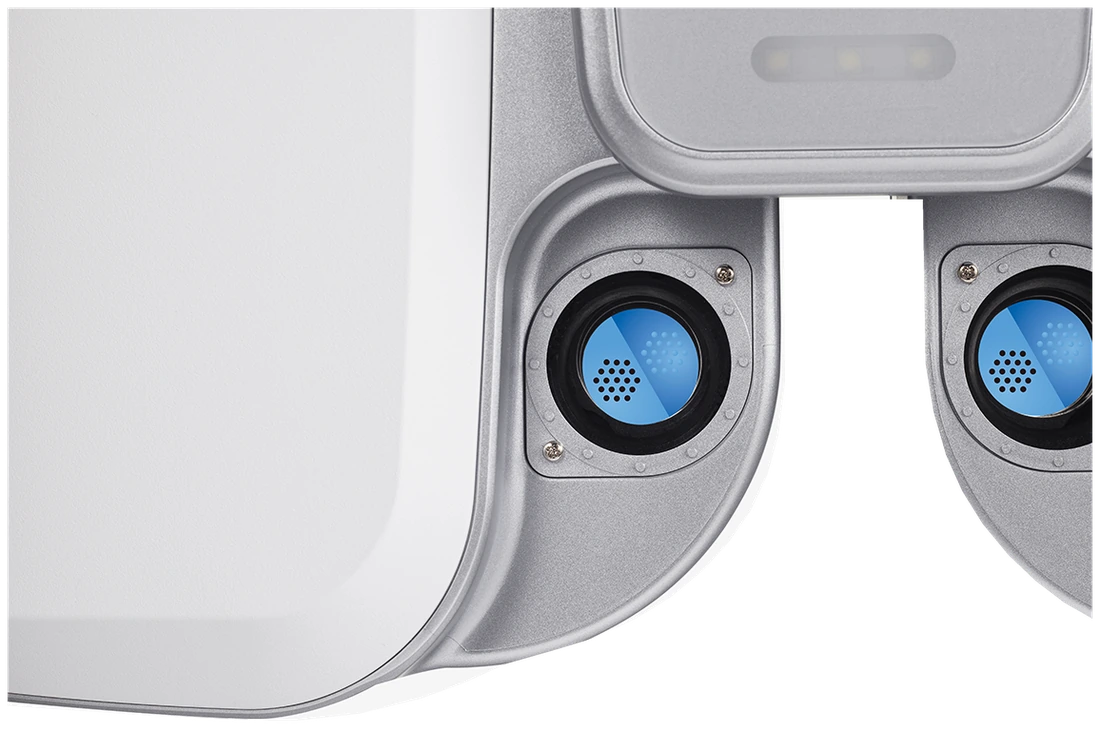
Designed for daily practice
Explore the documented features and practical configuration of HDR-7100P.
Set up the near examination
Near working distance adjusts from 35 to 70 cm. The brochure specifies a 48–80 mm pupillary-distance range and a separate 50–74 mm near range.
- Near working distance from 35 to 70 cm.
- Near pupillary distance from 50 to 74 mm.
More product details
7100P refractor
Monocular PD adjustment supports personalised refraction. A sensor built into the headrest checks whether the patient is correctly positioned.
Measurement range
Spherical lens: Standard range: -29.00D to +26.75D During cross or prism tests (XC): -19.00D to +16.75D Available increments: 0.12D / 0.25D / 0.5D / 1D / 2D / 3D / 4D Cylindrical lens: Range: 0.00D to ±8.75D Available increments: 0.25D / 0.5D / 1D / 2D / 3D Cylinder axis: Range: 0˚ to 180˚ Available increments: 1˚ / 5˚ / 15˚ Pupillary distance (PD): Range: 48 mm to 80 mm Available increments: 0.5 mm / 1 mm Near PD: 50 mm to 74 mm Near working distance: Range: 35 cm to 70 cm Rotary prism lens: Range: 0△ to 20△ Available increments: 0.1△ / 0.2△ / 0.5△ / 1△ / 2△ 2. Specific lenses: Cross cylinder: ±0.25D ±0.50D Split lens with ±0.25D prism (dual cross cylinder). Retinoscopy lens: Options: +1.5D / +2.0D Corresponding working distances: 67 cm (for +1.5D) and 50 cm (for +2.0D).
An information system for practices and clinics
• Comprehensive network solution: Integration and centralised management support an efficient IT environment. • Multiple interfaces for straightforward installation: Compatibility with different instruments accommodates varied requirements. • Connection to different chart displays: Integration with projectors, vision charts and LCD charts. Wired and wireless options provide flexibility. • Integrated data management: A PC communication interface integrates patient data. Centralised, organised management simplifies workflows. • Efficient connection of multiple systems: Integration with autorefractometers/keratometers and automatic lensmeters. Shared connections between digital systems optimise costs and reduce hardware requirements. • Simultaneous data sharing: Organises and manages the refraction testing environment. Supports collaboration between instruments and systems. • Greater efficiency: Designed to optimise operating efficiency and costs in modern practices and clinics.
Integrated image gallery
Colour vision tests, Amsler grids, near vision charts, progressive lens guides and eye/refraction diagrams provide visual resources for detailed, informative examinations.
Technical information
Technical specifications & documentation
Product information, specifications and available documentation in one place.
Product specifications overview
Key documented information for this exact model.
Technical specifications
- Minimum sphere
- -29 DStandard examination.
- Maximum sphere
- 26.75 DStandard examination.
- Maximum cylinder
- 8.75 D
- Maximum prism
- 20 Δ
- Adjustment ranges
- Pupillary distance 48–80 mm; near distance 35–70 cm
- Power supply
- 100–240 V AC ; 50–60 Hz
- Dimensions
- 368.7 × 106.4 × 345.5 mmRefractor head only.
- Weight
- 4.2 kgHead only, panel and control box excluded.
Standard examination.
Refractor head only.
Head only, panel and control box excluded.
Downloads & resources
Available product sheets and public manufacturer resources.
No public manufacturer document has been verified for this model. Contact ASEM for the available documentation.
Sources and documentation
- https://huvitz.com/wp-content/uploads/2024/10/20230721_HDR-7100P_kor_catalog_v1_.pdfVerified on 2026-10-05
- https://huvitz.com/wp-content/uploads/2024/10/20230721_HDR-7100P_kor_catalog_v1_.pdfVerified on 2026-10-18
Frequently asked questions
Your questions about HDR-7100P
Clear answers based on the available product information.

What is the documented Minimum sphere of HDR-7100P?
-29 D — Standard examination.
View sourceWhat is the documented Maximum sphere of HDR-7100P?
26.75 D — Standard examination.
View sourceWhich configuration should I confirm for HDR-7100P?
Standard examination.
View sourceIs the sphere range unchanged with prisms?
No. The brochure gives −29 to +26.75 D for standard examination and −19 to +16.75 D for cross-cylinder or prism testing. This distinction needs to be retained in the protocol.
View sourceWhich retinoscopy lenses are documented?
The specification gives +1.5 D for 67 cm and +2.0 D for 50 cm. The choice corresponds to the practitioner’s working distance.
View sourceWhich settings apply specifically to near vision?
Working distance runs from 35 to 70 cm and near pupillary distance from 50 to 74 mm. These are distinguished from the general 48–80 mm pupillary-distance range.
View sourceASEM support
More than a device, a long-term partnership
Discuss your project with ASEM: equipment selection, installation, training and technical support.
Installation
Discuss the installation requirements and configuration with our technical team.
Learn more

After-sales service
Contact ASEM for technical assistance and the support appropriate to your equipment.
Learn more

Related products
Explore equipment with related technologies and clinical uses.
Clinical applications
Explore the ASEM clinical catalogue
Browse related areas of the ASEM catalogue. These links do not extend the indications of this device.
Explore all products