
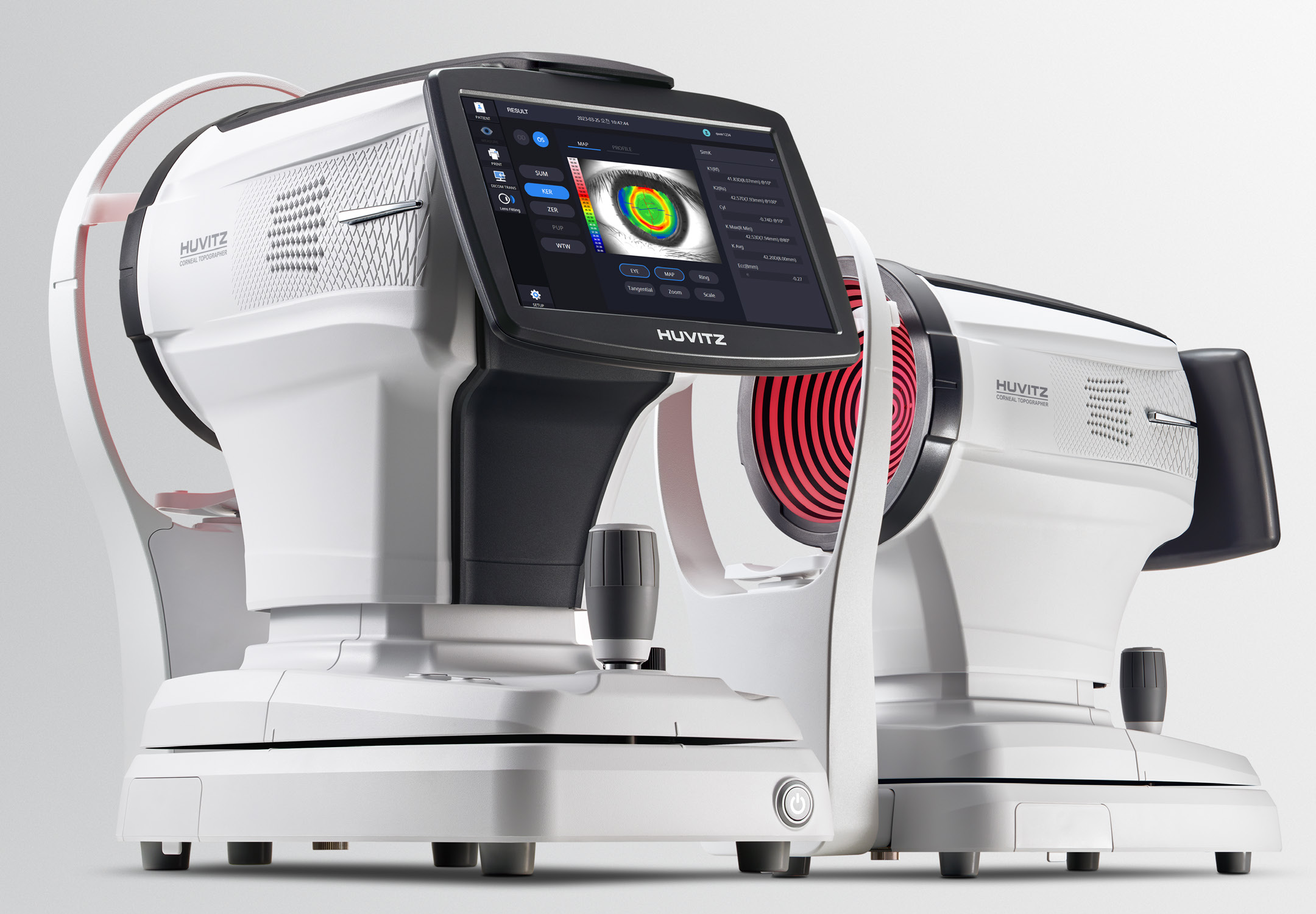
HTG-1
Corneal topography with keratometry and Zernike analysis.
HTG-1 Corneal topography and contact lens fitting with HIS-1 software for patient monitoring.
Key advantages
The documented strengths of HTG-1, at a glance.
Corneal mapping
Topographic mapping of the corneal surface.
Zernike analysis
Corneal aberration analysis using Zernike terms.
Integrated keratometry
Corneal curvature measurement in the same examination.
Capabilities in practice
A closer look at the functions and technology of HTG-1.
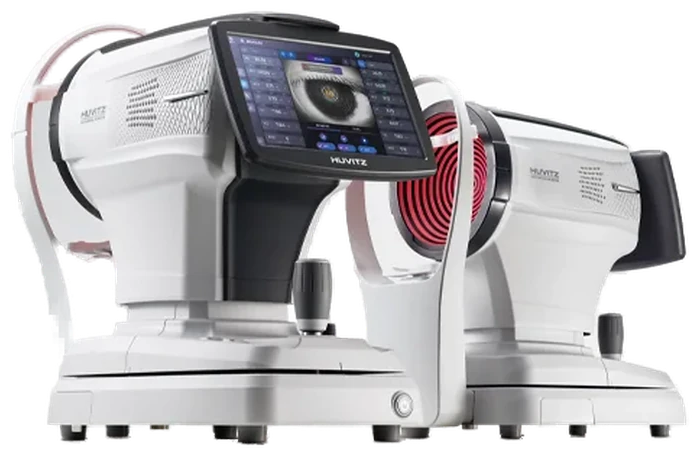
Map the corneal surface with Placido
The 24 Placido rings support axial, tangential, refractive-power and elevation maps. This topography describes the corneal surface; pachymetry is not inferred from these maps.
- 24 Placido rings.
- More than 6,220 measured points; more than 100,000 analysed points.
Combine corneal shape and optical analysis
Zernike coefficients complement keratometry values. The system also presents keratoconus indices, pupillometry and white-to-white distance.
- Keratometry and Zernike aberration decomposition.
- Keratoconus indices, pupillometry and white-to-white.
Compare corneal representations
The maps show corneal shape through several complementary representations.
- Axial and tangential maps.
- Refractive-power and elevation maps.
Measure pupil and white-to-white
Diameter measurements complement curvature maps in the assessment.
- Pupil: 0.5–10 mm.
- White-to-white: 7–14 mm.
Designed for a smoother workflow
Organise maps and reports
Reports organise topography, SimK, meridians, keratoconus and white-to-white data. The manufacturer describes HIIS-1 review and DICOM compatibility for practice integration.
- Structured topographic-analysis reports.
- HIIS-1 review and DICOM communication according to configuration.
Depending on configuration
Simulate contact-lens fitting
The software provides a simulated fluorescein view from topographic data.
- Fitting simulation on the corneal profile.
- Calculated view, distinct from an image with fluorescein applied.
Product gallery
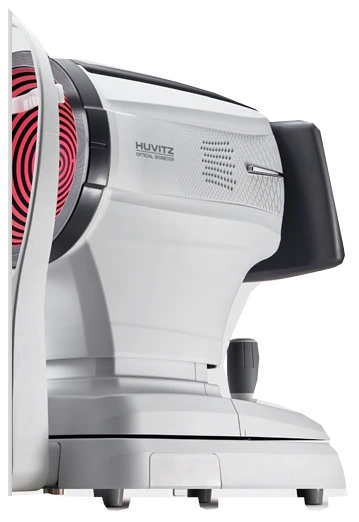
More product details
Corneal topography and analysis
Analysis projects concentric patterns onto the corneal surface to provide information on: • Keratometry: corneal curvature measurement. • Topography: corneal shape and irregularities. • Keratoconus: detection of specific abnormalities. • Zernike coefficients: optical aberration analysis. • Pupillometry: dynamic pupil measurement. • White-to-white distance: used in sizing certain implantable devices. • Virtual contact lens fitting. • Detailed axial, tangential, refractive power and elevation maps. • HIS-1 software for clinical analysis and ocular disease monitoring.
Advanced corneal analysis
HUVITZ corneal assessment technology supports precise assessment of complex conditions such as keratoconus and irregular astigmatism. Corneal mapping identifies irregularities and supports personalised treatment. The HUVITZ topographer assists postoperative monitoring and contact lens or implant fitting. Comprehensive analysis of curvature, optical aberrations and refractive power.
Aberrometry and Zernike analysis
Detects optical aberrations of the corneal surface. HTG decomposes optical aberrations according to visual defects, including higher-order aberrations. Supports assessment of corneal conditions such as keratoconus and irregular astigmatism. Helps plan personalised refractive surgery and precise contact lens fitting.
Dynamic pupillometry
The HTG-1 precisely measures pupil dimensions, including under mesopic conditions, and decentration. Maps and graphs present these analyses clearly for implant-related assessment.
White-to-white measurement
• Intraocular lenses (IOLs) and phakic lenses. • Refractive surgery and intracorneal rings. White-to-white measurement assesses corneal size when planning certain surgical or corneal procedures. • Specialised contact lens and scleral lens fitting. • Assessment and monitoring of corneal disease and morphological abnormalities.
Technical information
Technical specifications & documentation
Product information, specifications and available documentation in one place.
Product specifications overview
Key documented information for this exact model.
Technical specifications
- Software
- HIIS; manufacturer-stated DICOM compatibility
Downloads & resources
Available product sheets and public manufacturer resources.
No public manufacturer document has been verified for this model. Contact ASEM for the available documentation.
Sources and documentation
- https://huvitz.com/ko/product/htg-1/Verified on 2026-10-05
- https://huvitz.com/ko/product/htg-1/Verified on 2026-10-18
- https://huvitz.com/wp-content/uploads/2025/02/HTG-1_6p_eng_240115_v2.pdfVerified on 2026-10-18
Frequently asked questions
Your questions about HTG-1
Clear answers based on the available product information.

What is the documented Software of HTG-1?
HIIS; manufacturer-stated DICOM compatibility
View sourceAre over 100,000 points all measured directly?
The specification distinguishes over 100,000 analysed points from over 6,220 measured points. The analysed total should not be presented as a direct-measurement count.
View sourceWhat is the difference between measured and analysed points?
The specification distinguishes more than 6,220 measured points and more than 100,000 analysed points from 24 Placido rings. The two counts are not interchangeable.
View sourceIs the lens simulation a photograph with dye?
No. The fluorescein view is a software simulation calculated for fitting from topography. It is distinct from a photograph taken after fluorescein application.
View sourceASEM support
More than a device, a long-term partnership
Discuss your project with ASEM: equipment selection, installation, training and technical support.
Installation
Discuss the installation requirements and configuration with our technical team.
Learn more

After-sales service
Contact ASEM for technical assistance and the support appropriate to your equipment.
Learn more

Related products
Explore equipment with related technologies and clinical uses.
Clinical applications
Explore the ASEM clinical catalogue
Browse related areas of the ASEM catalogue. These links do not extend the indications of this device.
Explore all products