
HRK-1
Refraction, keratometry and contact lens fitting assistance.
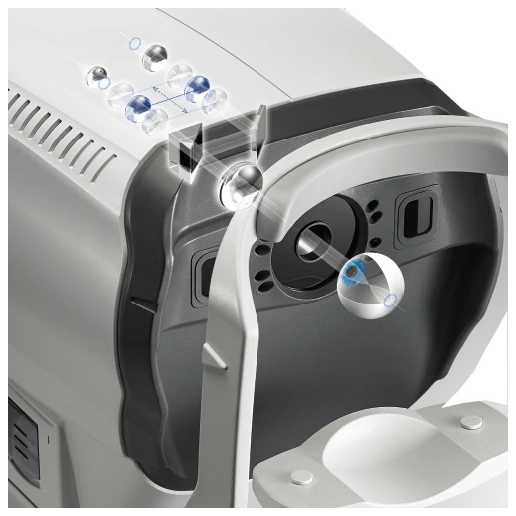
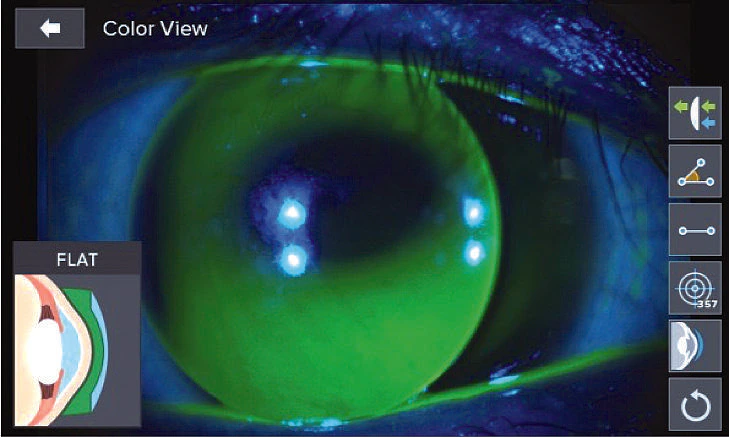
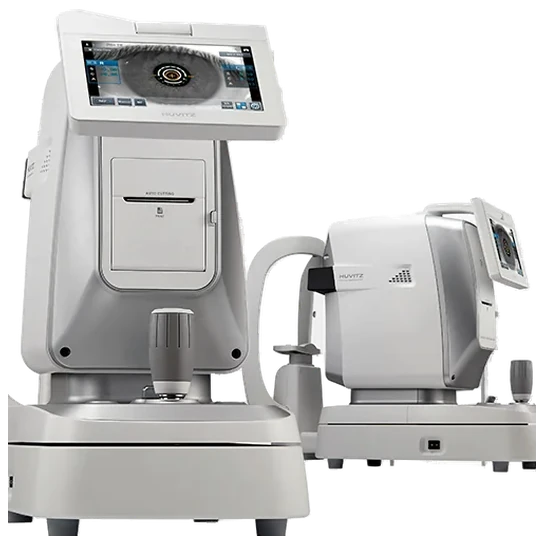
The Huvitz HRK-1 combines refractometry and keratometry for objective refraction and corneal curvature measurements. Smart Assembly Moving Control adjusts the optical assembly to the patient’s refraction. Aiming Dot assists alignment, while Color View supports observation and contact lens fitting. Results can be viewed on the colour touch display and printed using the built-in thermal printer.
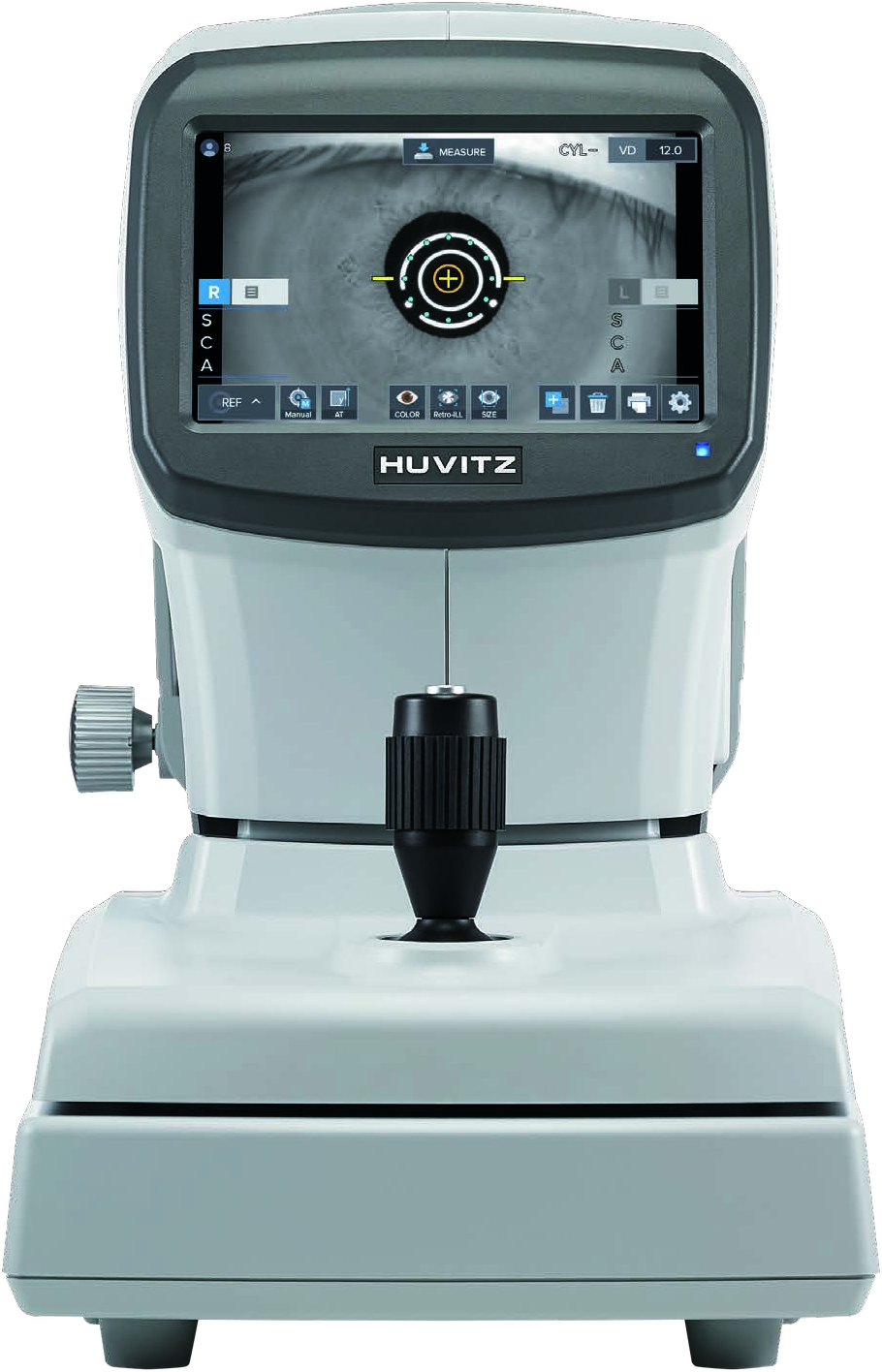
Key advantages
The documented strengths of HRK-1, at a glance.
Refraction and cornea
Refractometry and keratometry in a single instrument.
Contact lens fitting
Assistance with contact lens fitting.
Vertical tracking
Vertical positioning tracking over ±15 mm.
Capabilities in practice
A closer look at the functions and technology of HRK-1.
Signal-guided refraction
SAMC automatically adjusts movement of the optical assembly to the refractive error to stabilise the measurement signal.
- Sphere: −30 to +25 D at VD 12 mm.
- Cylinder: up to ±12 D; axis from 0° to 180°.
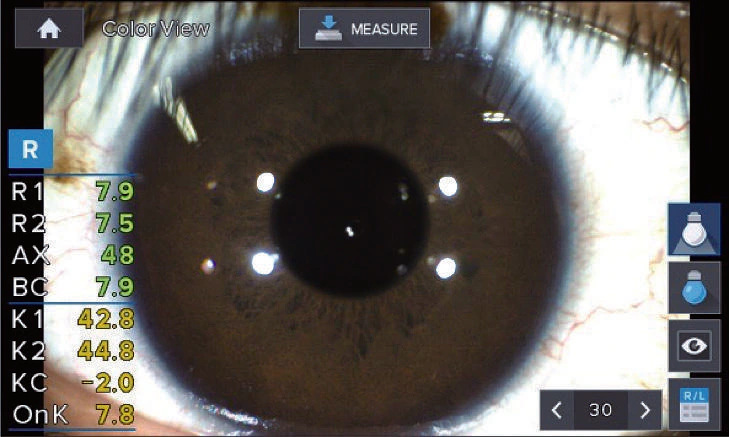
Colour and retro-illumination views
The colour camera and white LED show the eye and contact-lens fitting. Retro-illumination provides an additional view of opacities.
- Colour camera and white LED illumination.
- Dedicated retro-illumination mode.
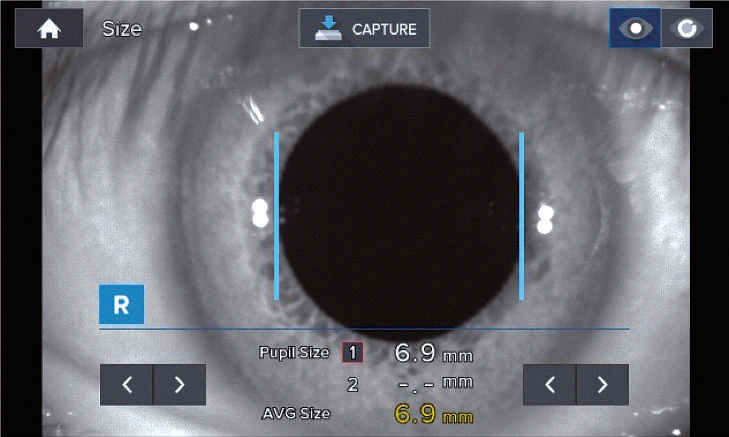
Measure iris and pupil
The colour capture allows diameter markers to be positioned on the eye image.
- Iris/pupil diameter range: 2–14 mm.
- Minimum pupil for refraction: 2 mm.
Designed for a smoother workflow
Locate, then align
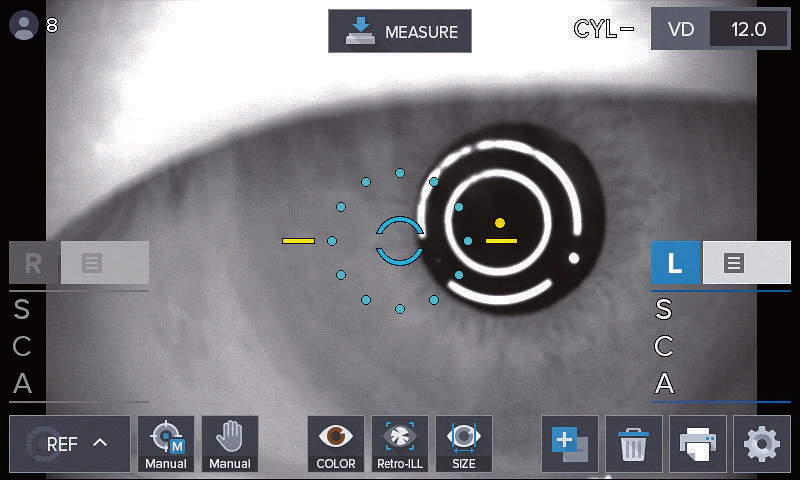
The Aiming Dot helps locate the visual apex. Vertical tracking then supports positioning while the joystick controls the approach.
- Automatic vertical tracking over ±15 mm.
- Approach and centration controlled by the joystick.
Product gallery
Designed for daily practice
Explore the documented features and practical configuration of HRK-1.
Support rigid-lens fitting
The On-K guide calculates a base curve from keratometry values. The brochure limits this function to rigid gas-permeable lenses.
RGP lenses only
- Base-curve calculation from KER values.
- Fluorescein viewing with a yellow filter.
Review and transfer results
The 7-inch touchscreen displays results; the printer produces them after measurement.
- Memory for ten measurements per eye.
- RS-232; HLM-1 printer link through an optional Y-cable.
Documented installation and configuration
Manufacturer dimensions: 261 mm width × 513 mm depth × 433 mm height. Weight: 16 kg. Power supply: 100–240 V AC, 50/60 Hz. Accessories, integration with other devices and installation requirements must be confirmed with ASEM for the proposed configuration. No additional software compatibility is inferred solely from the product family name.
Technical information
Technical specifications & documentation
Product information, specifications and available documentation in one place.
Product specifications overview
Key documented information for this exact model.
Technical specifications
- Minimum sphere
- -30 DVertex distance 12 mm.
- Maximum sphere
- 25 D
- Maximum cylinder
- 12 D
- Minimum pupil diameter
- 2 mm
- Connectivity
- RS-232C
- Adjustment ranges
- Vertical tracking ±15 mm
- Power supply
- 100–240 V AC ; 50–60 Hz
- Dimensions
- 261 × 513 × 433 mm
- Weight
- 16 kg
Vertex distance 12 mm.
Downloads & resources
Available product sheets and public manufacturer resources.
Sources and documentation
- https://huvitz.com/wp-content/uploads/2024/10/HRK-1_8p_eng_20170907.pdfVerified on 2026-10-05
- https://www.huvitz.com/product/hrk-1/Verified on 2026-10-06
- https://huvitz.com/wp-content/uploads/2024/10/HRK-1_8p_eng_20170907.pdfVerified on 2026-10-06
- https://huvitz.com/wp-content/uploads/2024/10/HRK-1_8p_eng_20170907.pdfVerified on 2026-10-18
Frequently asked questions
Your questions about HRK-1
Clear answers based on the available product information.

What is the documented Minimum sphere of HRK-1?
-30 D — Vertex distance 12 mm.
View sourceWhat is the documented Maximum sphere of HRK-1?
25 D
View sourceWhich configuration should I confirm for HRK-1?
Vertex distance 12 mm.
View sourceWhere can I find the documentation for HRK-1?
Manufacturer documentation (PDF) — https://asem-medical.com/storage/catalogue-enrichment/huvitz-20261006/hrk1-original.pdf
View sourceIs tracking fully three-dimensional?
The brochure describes automatic vertical tracking. The operator positions the device with the joystick; fully automatic XYZ tracking is not specified for HRK-1.
View sourceWhich lenses does the On-K guide support?
The brochure limits it to rigid gas-permeable lenses. It uses keratometry values to suggest a base curve.
View sourceWhat refraction range is documented?
At VD 12 mm, sphere runs from −30 to +25 D and cylinder up to ±12 D. The stated minimum pupil is 2 mm.
View sourceASEM support
More than a device, a long-term partnership
Discuss your project with ASEM: equipment selection, installation, training and technical support.
Installation
Discuss the installation requirements and configuration with our technical team.
Learn more

After-sales service
Contact ASEM for technical assistance and the support appropriate to your equipment.
Learn more

Related products
Explore equipment with related technologies and clinical uses.
Clinical applications
Explore the ASEM clinical catalogue
Browse related areas of the ASEM catalogue. These links do not extend the indications of this device.
Explore all products