
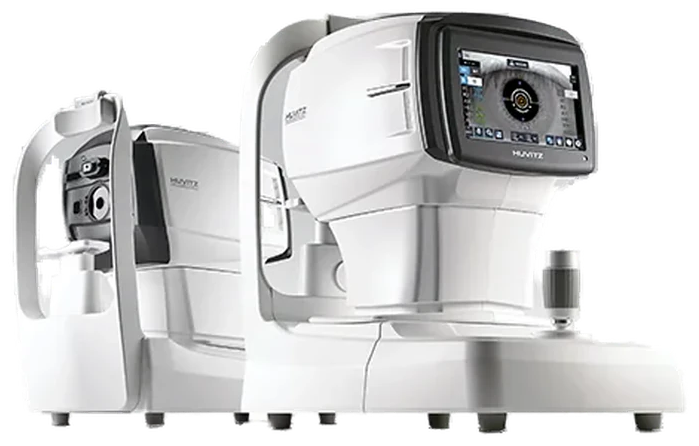
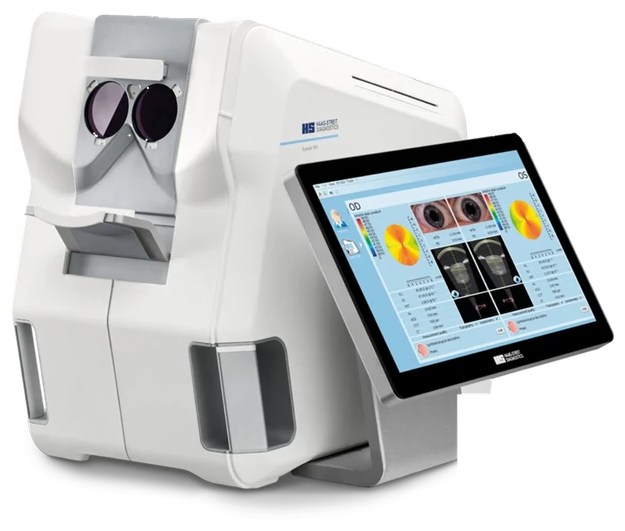
HTR-1A
Refraction, cornea and intraocular pressure in a combined platform.
Two refraction examination measurements combined.
Key advantages
The documented strengths of HTR-1A, at a glance.
Refraction and keratometry
Two refraction examination measurements combined.
Non-contact tonometry
Intraocular pressure measurement without contact.
Corneal pachymetry
Corneal thickness measurement in the same instrument.
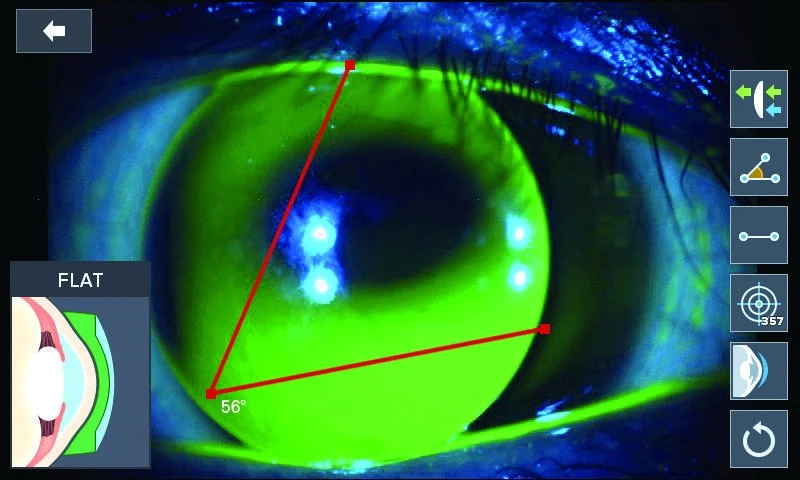
Prepare lens fitting
The fitting guide documents parameters used for contact-lens fitting.
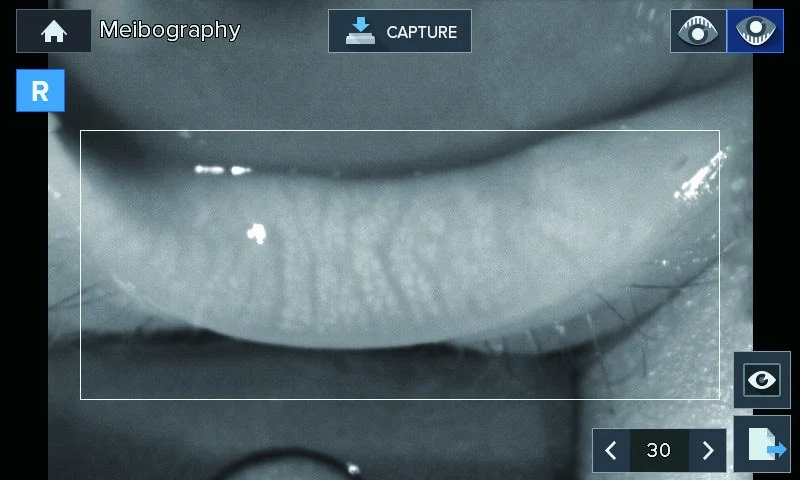
Review meibomian glands
The meibography view complements ocular-surface assessment in the same workflow.
Document the tear film
TFBUT analysis displays timing markers used to review tear-film stability.
Capabilities in practice
A closer look at the functions and technology of HTR-1A.
Bring four measurements to one station
HTR-1A combines refraction, keratometry, non-contact tonometry and pachymetry. The patient remains at the same station for these four instrument measurements.
- Refraction and keratometry at one station.
- Integrated non-contact tonometry and pachymetry.
Manufacturer illustration: the configuration shown may differ from the delivered configuration.
Add ocular-surface views
Manufacturer-documented Color View, TFBUT and meibography views complement the assessment. The fitting guide and peripheral keratometry provide contact-lens information.
- TFBUT and meibography in the interface.
- Colour view for surface and contact-lens observation.
Manufacturer illustration: the configuration shown may differ from the delivered configuration.
Support contact-lens fitting
The fitting guide uses blue illumination and peripheral keratometry values.
- Fitting observation with fluorescein.
- Curvature review around the corneal centre.
Designed for a smoother workflow
Track the measurement point in three dimensions
When the eye is within the tracking range, the three-dimensional mechanism aligns the measurement point and triggers acquisition. One control starts the two-eye measurement sequence.
- Three-dimensional automatic tracking and shooting.
- Two-eye measurement sequence from one control.
Designed for daily practice
Explore the documented features and practical configuration of HTR-1A.
Fast workflow
Steps remain easy to sequence.
Readable data
Results are easy to review.
Workflow continuity
Measurement fits into consultation.
Team comfort
Daily use remains structured.
More product details
Main features
4-in-1 system integrating: Autorefractometer/keratometer. Air-puff tonometer. Pachymeter. Automatic eye tracking. Automatic measurement capture. Monitoring before and after refractive surgery. Personalised contact lens prescribing. Contact lens fitting and automatic recognition. Personalised IOP measurement. Intelligent air-puff control with automatic IOP adjustment. Corneal thickness compensation. Zernike maps for customised lenses. Pupil measurement down to 2 mm. Iris measurement up to 14 mm. Zernike maps and graphs can be displayed in 2D and 3D to interpret sphere, cylinder, axis and higher-order aberration data. KER/REF measurement with a high-intensity mire ring and two focused LED sources for reliable keratometry data. Precise refraction measurements reduce the influence of accommodation. Iris and pupil measurement using image capture. Iris measurement up to 14 mm. Pupil measurement down to 2 mm. Zernike maps for customised lenses. Zernike maps and graphs can be displayed in 2D and 3D to interpret sphere, cylinder, axis and higher-order aberration data. Colour mode for contact lens prescribing. Contact lens fitting. Automatic recognition of lens fit. Image processing with fluorescence and a cobalt blue filter. Automatic calculation of the contact lens base-curve radius. Contrast image capture and assessment of rigid gas-permeable (RGP) lens fitting. Automatic display of lens base-curve data. Retro-illumination mode to observe lens opacity or corneal damage. SPH, CYL and AXIS measurement data. TFBUT function for tear film break-up time and dry eye assessment. Meibography with image enhancement. Peripheral corneal measurement for contact lens fitting, continuously measuring corneal curvature superiorly, inferiorly, left and right from the corneal centre.
Technical specifications
Refraction measurement Sphere (SPH): -30.00 to +25.00 D Cylinder (CYL): 0.00 to ±12.00 D Axis (AX): 0 to 180° Pupillary distance (PD): 10 to 85 mm Minimum pupil diameter: Ø2.0 mm Corneal curvature measurement: Curvature radius: 5.0 to 13.0 mm Corneal refractive power: 25.96 to 67.50 D Corneal astigmatism: 0.0 to -15.00 D Astigmatism axis: 0 to 180° Corneal diameter: 2.0 to 14.0 mm Intraocular pressure (IOP) measurement: Measurement range: 1 to 60 mmHg Accuracy: ±5.0 mmHg Central corneal thickness (CCT) measurement: Measurement range: 300 to 800 µm Accuracy: ±10.0 µm User interface: 7-inch colour IPS LCD screen tilting to 85°, with a resistive touchscreen for intuitive navigation. Connectivity: RS-232C, USB, Ethernet and Wi-Fi interfaces for integration with other instruments and medical information systems. Dimensions: 301 mm (W) x 535 mm (D) x 506 mm (H) Weight: approximately 19 kg.
Why choose the HTR-1A?
Multifunctional medical instrument Integrated refraction, keratometry, pachymetry and tonometry for comprehensive clinical assessment. Support for complex conditions Provides key information for diagnosing and managing corneal, refractive and glaucomatous conditions. Workflow efficiency Shorter examinations with greater reliability support both care quality and practice efficiency.
Advanced medical features
1. Corneal biomechanical analysis By combining pachymetry and non-contact tonometry, the HTR-1A provides individual IOP assessment corrected for central corneal thickness (CCT). Supports identification of patients at increased risk of glaucoma or corneal disease. 2. Contact lens fitting Advanced keratometry precisely measures curvature radius and corneal astigmatism axes, assisting rigid and toric lens fitting. Detailed monitoring assesses lens stability and comfort over time. 3. Multifocal refraction assessment An optimised refraction algorithm for patients with cataract or accommodative disorders supports precise dynamic visual acuity assessment, including in low light. 4. Detection of corneal disorders Retro-illumination reveals corneal irregularities, including opacities or dystrophies, supporting early assessment of conditions that could compromise surgery. 5. Detailed astigmatism mapping Detailed corneal and refractive aberration analysis supports refractive procedures such as LASIK and toric IOL implantation.
Technical information
Technical specifications & documentation
Product information, specifications and available documentation in one place.
Product specifications overview
Key documented information for this exact model.
- Brand
- Huvitz
- Model
- HTR-1A
- Technology
- Refractor / auto-refractor
- Clinical use
- Diagnostics and biometry
Technical specifications
- Minimum sphere
- -30 DVertex distance 12 mm.
- Maximum sphere
- 25 D
- Maximum cylinder
- 12 D
- Minimum pupil diameter
- 2 mm
- Connectivity
- RS-232 · USB for maintenance · Ethernet · Wi-Fi · External video output
- Adjustment ranges
- Total vertical 83 mm; lateral 90 mm; longitudinal 40 mm; chin rest 65 mm
- Power supply
- 100–240 V AC ; 50–60 Hz
- Dimensions
- 301 × 535 × 506 mm
- Weight
- 23.8 kg
Vertex distance 12 mm.
Downloads & resources
Available product sheets and public manufacturer resources.
No public manufacturer document has been verified for this model. Contact ASEM for the available documentation.
Sources and documentation
- https://huvitz.com/wp-content/uploads/2024/10/HTR-1A_8p_eng_20220222.pdfVerified on 2026-10-05
- https://huvitz.com/wp-content/uploads/2024/10/HTR-1A_8p_eng_20220222.pdfVerified on 2026-08-30
- https://huvitz.com/en/product/htr-1a/Verified on 2026-08-30
- https://huvitz.com/ko/product/htr-1a/Verified on 2026-10-18
Frequently asked questions
Your questions about HTR-1A
Clear answers based on the available product information.

What is the documented Minimum sphere of HTR-1A?
-30 D — Vertex distance 12 mm.
View sourceWhat is the documented Maximum sphere of HTR-1A?
25 D
View sourceWhich configuration should I confirm for HTR-1A?
Vertex distance 12 mm.
View sourceHow does it differ from an auto ref-keratometer alone?
HTR-1A adds non-contact tonometry and pachymetry to refraction and keratometry. All four functions are described for this integrated model.
View sourceWhat does automatic tracking do?
Once the eye is in the tracking range, the mechanism follows in three dimensions, aligns the measuring point and triggers capture. The practitioner prepares patient positioning.
View sourceDoes the device offer only the four main measurements?
No. The manufacturer also describes Color View, TFBUT, meibography, contact-lens fitting guidance and peripheral keratometry.
View sourceASEM support
More than a device, a long-term partnership
Discuss your project with ASEM: equipment selection, installation, training and technical support.
Installation
Discuss the installation requirements and configuration with our technical team.
Learn more

After-sales service
Contact ASEM for technical assistance and the support appropriate to your equipment.
Learn more

Related products
Explore equipment with related technologies and clinical uses.
Clinical applications
Explore the ASEM clinical catalogue
Browse related areas of the ASEM catalogue. These links do not extend the indications of this device.
Explore all products