
HRK-9000A
Refraction and ocular surface assessment in one instrument.
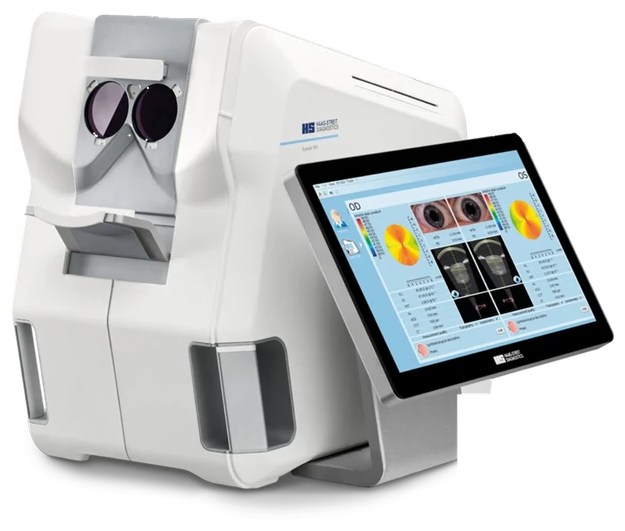
The Huvitz HRK-9000A combines advanced technology and versatility for detailed ophthalmic diagnostics. Designed for demanding professionals, it brings new capabilities to refraction and keratometry.

Key advantages
The documented strengths of HRK-9000A, at a glance.
Automatic refraction
Sphere from −30 to +25 D; cylinder up to 12 D.
Ocular surface
Meibography and tear film break-up time analysis.
Peripheral keratometry
Central and peripheral corneal curvature measurements.
Capabilities in practice
A closer look at the functions and technology of HRK-9000A.
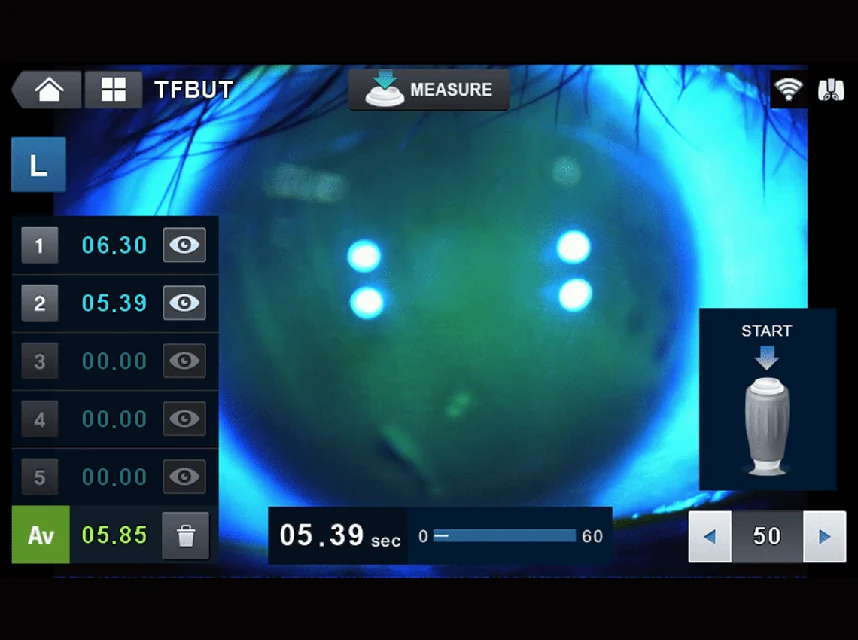
Manufacturer illustration: the configuration shown may differ from the delivered configuration.
Document tear film and glands
TFBUT provides a time-based tear-film measurement. Meibography allows observation of meibomian glands alongside refraction and keratometry.
- Tear-film break-up time measurement: TFBUT.
- Meibomian-gland observation through meibography.
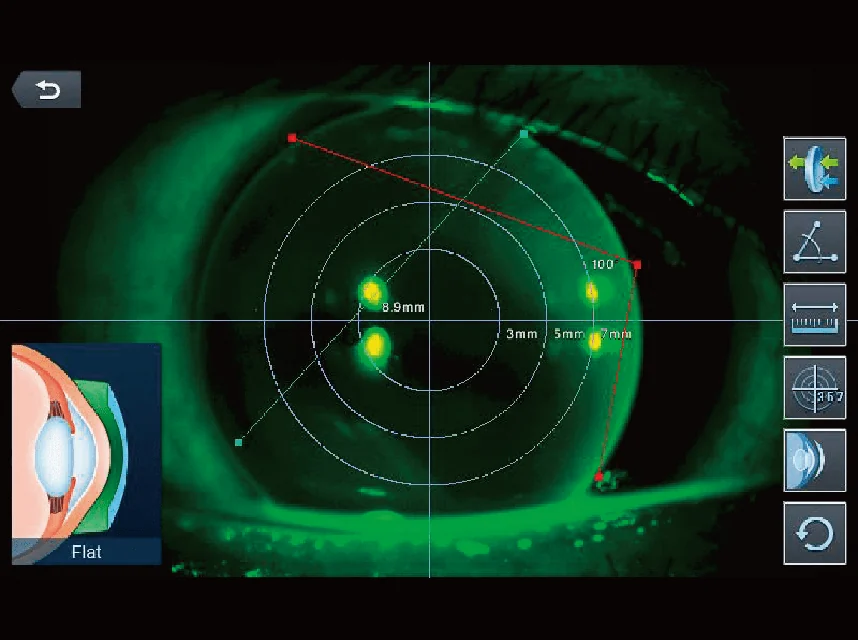
Manufacturer illustration: the configuration shown may differ from the delivered configuration.
Review peripheral corneal curvature
Peripheral keratometry records curvature and eccentricity around the corneal centre. The fitting guide brings these values together with the blue-illumination view.
- Curvature and eccentricity around the corneal centre.
- Blue illumination for fitting observation.
Analyse the refractive wavefront
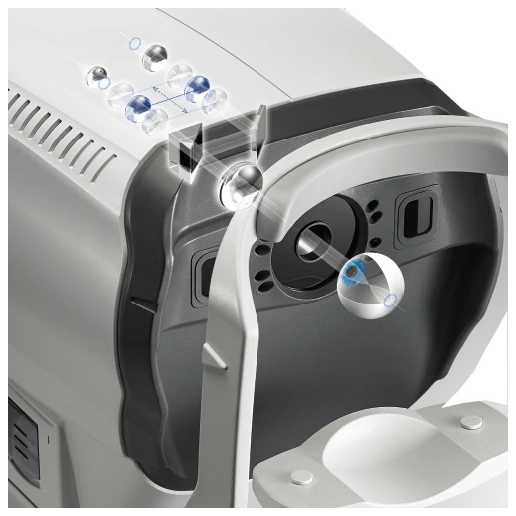
The microlens array samples the wavefront for objective refraction measurement.
- Sphere, cylinder and axis results.
- Dedicated IOL and retro-illumination modes.
Measure on the colour capture
The colour view shows the eye and allows iris and pupil diameters to be measured.
- Measurable diameters from 2 to 14 mm.
- Additional view for contact-lens observation.
Designed for a smoother workflow
Add the patient’s subjective response
The subjective visual-acuity test compares objective measurement with patient responses. Dedicated presentations support distance, near and glare comparison.
- Dedicated distance and near presentations.
- Glare visual-acuity mode.
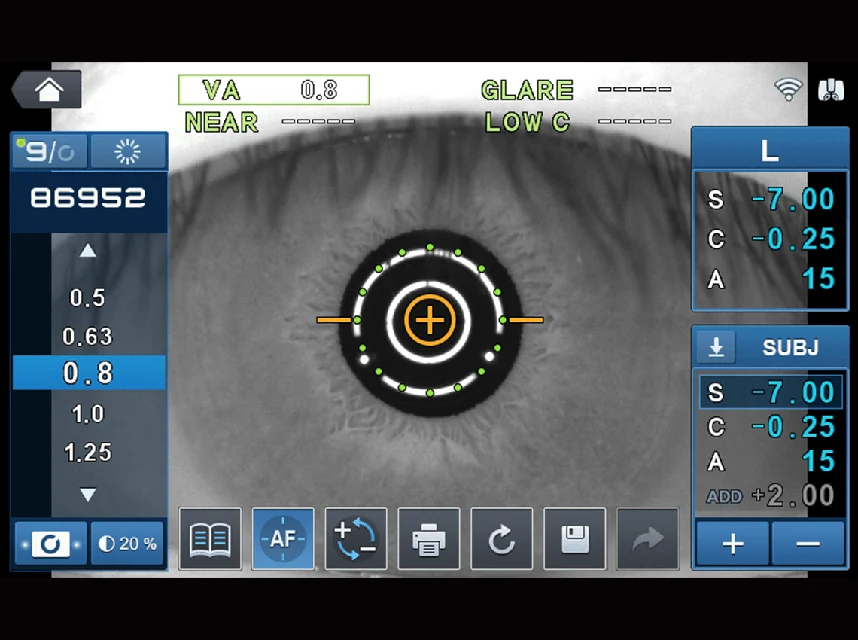
Manufacturer illustration: the configuration shown may differ from the delivered configuration.
Designed for daily practice
Explore the documented features and practical configuration of HRK-9000A.
Acquire and transfer measurements
Three-dimensional tracking supports centration and interfaces connect the station to compatible instruments.
- Tilting and swivelling 7-inch screen.
- Wi-Fi to HDR-9000/HLM-9000; RS-232 connection.
More product details
An essential tool for your practice
The HRK-9000A offers more than autorefraction and keratometry. It supports clinical efficiency while providing more comprehensive, precise diagnostic information.
Main features
Advanced wavefront technology: high-precision aberration analysis provides accurate refractive measurements beyond traditional methods. Contact lens fitting assistance: assess lens fit in real time with blue illumination to help optimise fitting for each patient. Meibomian gland and tear film analysis: comprehensive ocular health assessment, including tear film break-up time (TFBUT) measurement and detailed observation of the Meibomian glands. Wireless communication: Wi-Fi connects with other devices to simplify workflow and data integration.
Technical specifications
Refractive measurement range: sphere -30.00 to +25.00 D; cylinder up to ±12.00 D. Minimum pupil diameter: 2.0 mm for precise measurements even with small pupils. Display: tilting 7-inch colour TFT LCD touchscreen for ergonomic use. Dimensions and weight: 255 mm (W) x 550 mm (D) x 490 mm (H); weight 19 kg.
Benefits for healthcare professionals
Improved precision: wavefront technology goes beyond conventional autorefractors, providing reliable results for preoperative and postoperative patient management. Versatile tool: combines keratometry, refraction and tear gland analysis in one compact instrument. Clinical efficiency: speed and a smooth interface suit short consultations or practices with high patient volumes. Refractive surgery support: provides key data for LASIK and other corneal procedures.
Technical information
Technical specifications & documentation
Product information, specifications and available documentation in one place.
Product specifications overview
Key documented information for this exact model.
- Brand
- Huvitz
- Model
- HRK-9000A
- Technology
- Refractor / auto-refractor
- Clinical use
- Diagnostics and biometry
Technical specifications
- Minimum sphere
- -30 DVertex distance 12 mm.
- Maximum sphere
- 25 DVertex distance 12 mm.
- Maximum cylinder
- 12 D
- Minimum pupil diameter
- 2 mm
- Connectivity
- RS-232 · USB for maintenance · Wi-Fi 2.4 GHz
- Adjustment ranges
- Vertical ±15 mm; lateral and longitudinal tracking ±5 / ±2 mm
- Power supply
- 100–240 V AC ; 50–60 Hz
- Dimensions
- 255 × 550 × 490 mm
- Weight
- 19 kg
Vertex distance 12 mm.
Downloads & resources
Available product sheets and public manufacturer resources.
No public manufacturer document has been verified for this model. Contact ASEM for the available documentation.
Sources and documentation
- https://huvitz.com/wp-content/uploads/2024/11/20241014_HRK-9000A_eng_catalog_v2_%EC%B5%9C%EC%86%8C.pdfVerified on 2026-10-05
- https://huvitz.com/en/product/hrk-9000a/Verified on 2026-08-30
- https://huvitz.com/en/product/hrk-9000a/Verified on 2026-10-18
- https://huvitz.com/wp-content/uploads/2024/11/20241014_HRK-9000A_eng_catalog_v2_%EC%B5%9C%EC%86%8C.pdfVerified on 2026-10-18
Frequently asked questions
Your questions about HRK-9000A
Clear answers based on the available product information.

What is the documented Minimum sphere of HRK-9000A?
-30 D — Vertex distance 12 mm.
View sourceWhat is the documented Maximum sphere of HRK-9000A?
25 D — Vertex distance 12 mm.
View sourceWhich configuration should I confirm for HRK-9000A?
Vertex distance 12 mm.
View sourceCan pupil diameter be measured?
Yes. The brochure describes image-based iris and pupil diameter measurement from 2 to 14 mm in the dedicated mode.
View sourceDoes subjective acuity testing replace objective measurement?
It complements it with patient responses using distance, near and glare presentations. Objective refraction and keratometry remain separate measurements.
View sourceWhich ocular-surface tools are described?
The manufacturer describes TFBUT, meibography and colour viewing to complement examination, together with a contact-lens fitting guide under blue illumination.
View sourceASEM support
More than a device, a long-term partnership
Discuss your project with ASEM: equipment selection, installation, training and technical support.
Installation
Discuss the installation requirements and configuration with our technical team.
Learn more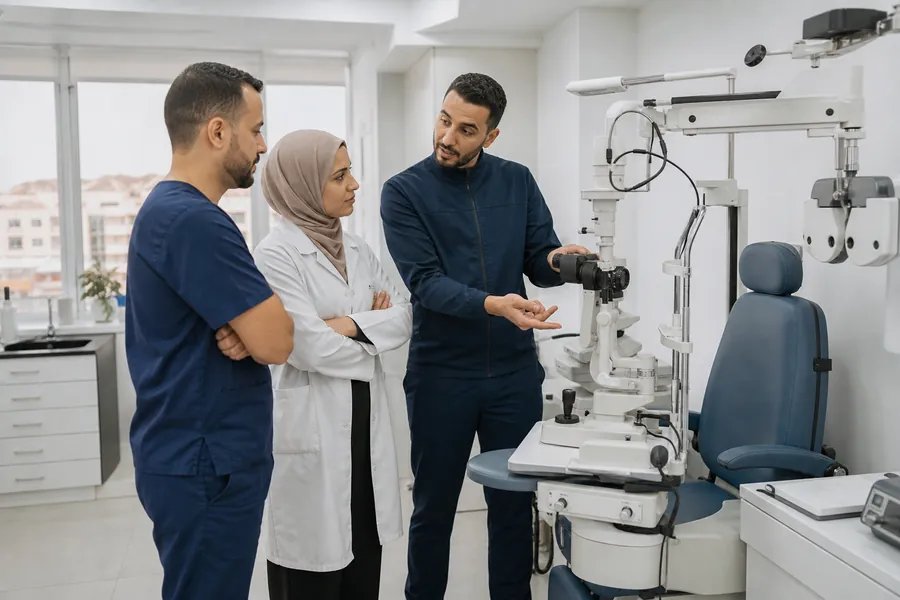

After-sales service
Contact ASEM for technical assistance and the support appropriate to your equipment.
Learn more

Related products
Explore equipment with related technologies and clinical uses.
Clinical applications
Explore the ASEM clinical catalogue
Browse related areas of the ASEM catalogue. These links do not extend the indications of this device.
Explore all products